





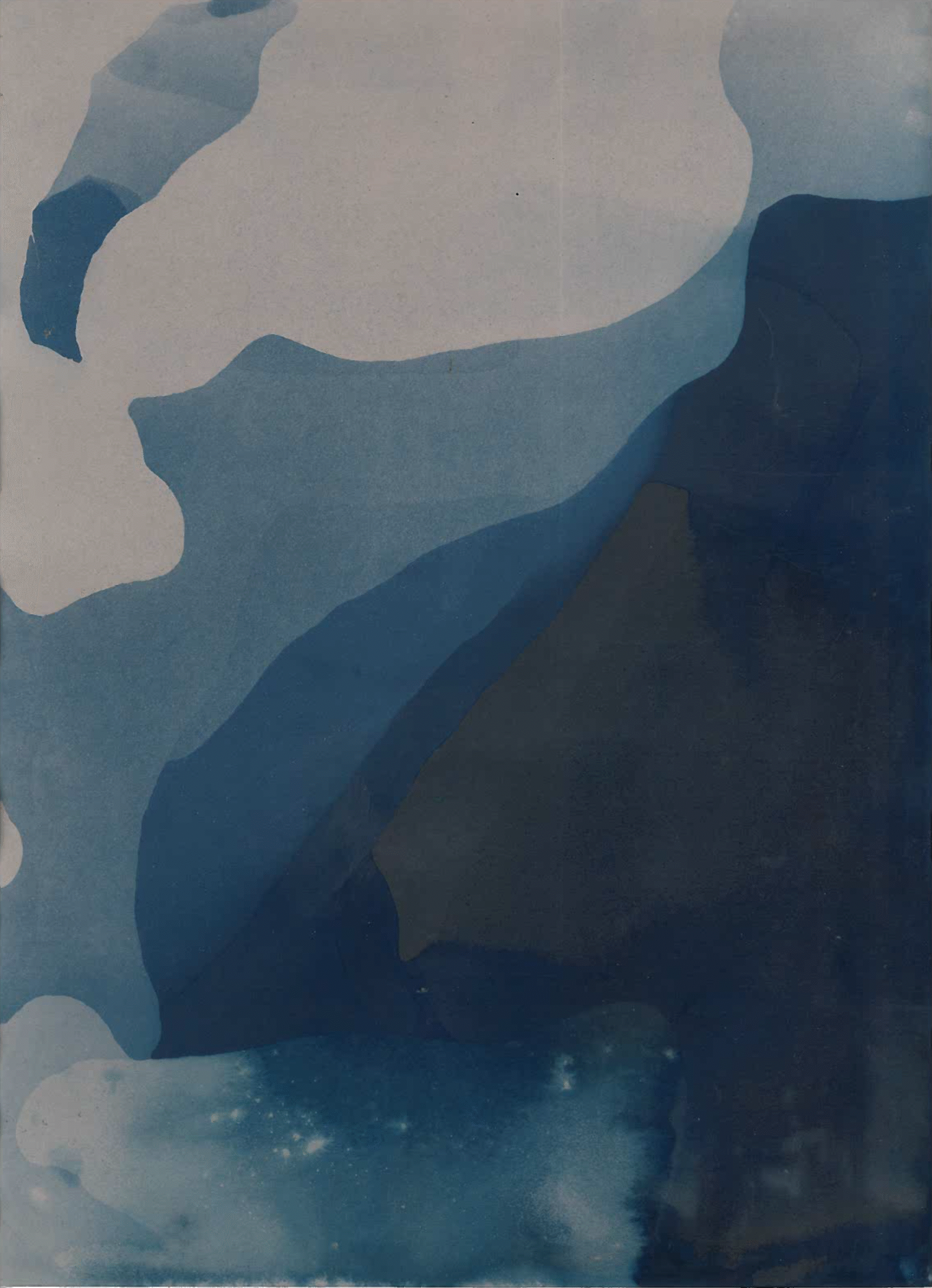
Jessica El Mal, Chahine Fellahi, Kaïs Aïouch, River Print 4. Cyanotype print on Canson paper, 42 x 29.7 cm (2022)
In recent years, I realized I have a neurosis relating to the sea. A couple summers ago, I went to a beach in Haifa with a few friends of mine. They all had Jerusalemite or 1948 IDs, giving them free access to the Mediterranean, as opposed to me and one other friend, who hold West Bank IDs that leave us locked in 5.8km.²
When it was time to leave the beach for dinner, I found myself feeling a palpable pain and heartache. My friend with the West Bank ID and I were looking longingly at the water, finding it physically and spiritually painful to leave it, and hugging and consoling each other. I looked around and saw our other friends calmly packing their belongings, with no existential crisis over leaving the shore.
I have now noticed this to be the case in any beach I go to, in any country. I am anxious to maximize my time by the water, and feel heartbroken when it’s time to depart. It feels akin to the emotional highs and lows of having a long-distance lover.
❂
Though the shape of my life has undoubtedly been determined by the occupation, having grown up in Ramallah, my direct experiences with the entity have been more in the realm of restrictions, random violence, or a permanent underlying feeling of insecurity. This is as opposed to the ongoing genocide or “boot stamping on a human face forever” that is experienced elsewhere in Palestine, in places away from the collaborationist and institutionalized centers of power.
I have thus always found it gauche to vocalize how my psyche is so traumatized by the “Diet Genocide” I have experienced. I am making a slight exception to this, to speak about my relationship to the sea.
❂
Maybe it’s because it feels like the most absolute form of freedom attainable – my body being weightless and fluid, my eyes only seeing an endless and open expanse, all of me covered in sand when I exit the sea but feeling completely unbothered.
Sunburnt and salt-dried, I let my physicality be transformed for the sake of water, like an almost holy mission. I surrender my body fully, leaving it to the mercy of natural forces, distanced from the man-made powers to which I am usually subject.
Maybe it’s because it feels like an obstacle course to get there – applying for a permit, failing to get a permit, your friend with a Jerusalem ID smuggling you in their car and praying soldiers don’t stop you, or sneaking through a literal hole in the Separation Wall.
The pleasure is heightened because of the dedicated effort; you feel you cheated the system and got what is rightfully yours. You escaped the claustrophobia of the synthetic borders encircling you, and regained your right to be in your world and its waters. When you have to leave, they are taking it away again.
❂
I meditate on these uniquely Palestinian pains, and how the earliest facts of our existence are shaped by them.
I used to think my first memory was something I invented, because it sounded too cliche to be real. I was hiding behind the deep blue sofa in the living room of my house, during the Second Intifada, and my mother was covering and shielding my small body with hers. I think there were tanks outside, or planes, I’m not entirely sure. The memory is hazy and unclear. I only found out it was real when my mother confirmed it a few months ago.
I ask my friends about their first memories, and find that all our early consciousness has been shaped by various pains from the occupation. My friend’s first memory is of Israeli soldiers raiding her family home in the middle of the night to arrest her eldest brother. She remembers loudly crying and screaming, and her father telling her to shush.
She tells me she’s stayed quiet ever since.
❂
I study the unnatural violence we face, and how it tampers with our cognition, our bodies, with the natural givens of our lives.
Someone else tells me a story of a woman whose husband was arrested and taken from their home by Israeli soldiers while she was pregnant. Due to the stress and the sheer heartache, her baby was born with a full head of white hair.
❂
I recently found out my paternal aunt is named Hejar, not as a Quranic reference, but because she was born in 1948, during my grandparents’ forced displacement from their massacred ancestral village. Having left al-Ramleh but not yet reached Ramallah, my grandmother gave birth to my aunt under a tree in Jifna. Hejar as in hijra, for migration.
I don’t know trees, I don’t know al-Ramleh, and I don’t know the fluidity of the natural world. I only know aged white stone, steel cages, and industrial Western concrete.
Yet, something in the pain of displacement still feels familiar.
❂
I move abroad, and find this condition of highly contextual pain, of agonizing affective experiences, to be inherent not only to Palestinianness but to Arabness as a whole.
A friend gets pulled over by a policeman for driving recklessly, and upon hearing the news of this marginal interaction with the state, all the Syrians in the room go into a panic.
Another man I meet tells me how he had planned to run away with his girlfriend when they were teens, smuggled across the sea from Libya into Europe. He got cold feet at the last minute, and she went without him. He never heard from her again, nor did her friends and family. He searches for her on the internet regularly, and gives me her full name so I can search too.
I talk to Iraqis, to Lebanese, to anyone, trying to reference and access other heartaches, and understand the unique complexes formed in each of our respective prisons / phantoms of nation-states.
I don’t even need to ask them to tell me; it is constantly spilling out of us.
❂
One day, I take a train to London from a southern seaside town, wearing a kuffiyeh, and I’ve barely taken my seat before I hear a man call me habbouba. I turn to face him, and he’s already grabbed his bags and come to sit across from me.
He tells me about his life; how he used to sell white in Germany, how he bought his mother a house in Alexandria but she passed away, and how he’s since sought asylum in the UK. Now, he’s going to London to resell puffer jackets sold to him by an Algerian in his asylum hostel.
He Facetimes his friend to introduce me to him, and describes me as a little bird.
I tell him I wish I was a fish instead.
❂
I think of this man selling coke and puffer jackets in the icy and wet landscapes of the imperial core.
I think of my Algerian great uncle, away from his homeland and family, dying alone in a French hospice.
I think of Walid Daqqa dying alone in a prison cell.
I think of my friend’s uncle who has no fingernails, due to being tortured in the prisons of a country my father tells me not to name in this piece.
I think of the 21,000 children missing in Gaza since October, and the 130,000 Syrians missing since 2011.
I don’t know how we hold all this pain, in all its variations, its micros and its macros, how we contain it inside us.
❂
I listen to Sanaa’ Mousa, Sheikh Imam, and Samih Choukeir, as I ride a London bus at midnight.
I listen to the varying constellations of our pain, and hold them all in my body as I watch the urban landscape go by. I feel resentful of my surroundings, and of the inequitable global distribution of grief and heartache.
❂
A few weeks later, in a French coastal town, I hear a group of Algerians laughing loudly on the shoreline, playing raï for the whole beach to hear. It brings me joy that we take their sea and make it ours. It saddens me that we are forced to.
I once again turn to the water, and all of the pain rippling in its depths.
I think of people in Gaza escaping fatal bombing but drowning to their deaths, as they attempt to catch air-dropped American aid which descends in a death-black jellyfish-like parachute.
I think of the unholy amount of lives lost trying to cross the Mediterranean onto bitter European shores.
I think of how, in Islam, drowning is a form of martyrdom.
❂
The sea feels like both a graveyard and an altar.
The water is the only thing that has ever felt holy, the only time I sensed the presence of a higher power. The boundless openness of the horizon, the deliverance from fabricated edges, the only breathing room I’ve ever been privy to – this endlessness has to be heavenly, I never tasted it on the earthly plane.
I worship the grace the water affords me, and mourn its desecration. I make sure to always say a prayer when I’m in the sea.
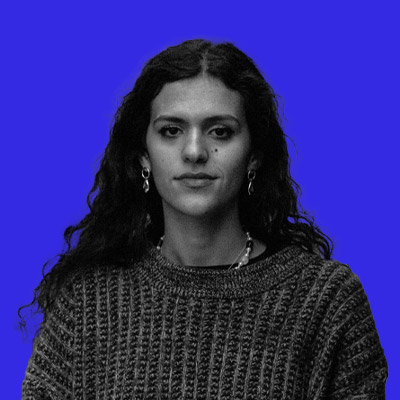
Shams Hanieh is a Palestinian-Algerian writer and researcher. Her work has been published in GQ Middle East, Trippin' World, AZEEMA, and elsewhere. Her creative writing comprises poetry and experimental prose, while her wider writing and research interests include Arabic hip-hop and visual art, and sexual and reproductive health in Palestine. She holds an MSc in Development Management from the London School of Economics.
