





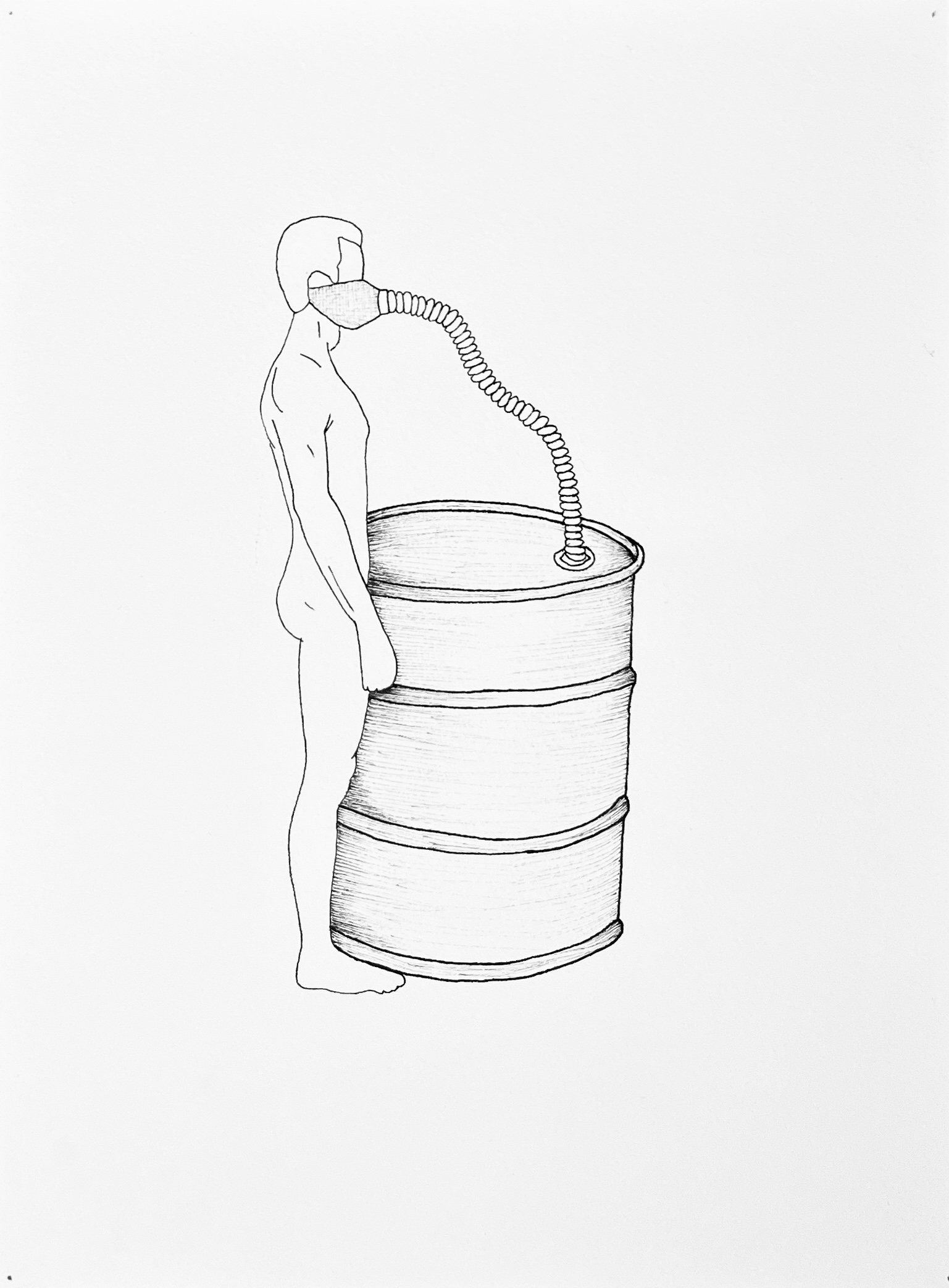
Mohamad Abdelkarim, Floating Limbs: The Case of Evolution/#7.
Pigment and ink on cotton paper, 29 x 25 cm (2022/2024)
A mule—confined, blinded, abused—is chained to a waterwheel. A horse arrives, and when the mule tries to enlist his fellow creature in a plot to tell the authorities about his mistreatment and exploitation, the horse rejects and ridicules him. Their discussion dilates to include more animals (a dove, a camel, a hyena, and a fox), and the narrative expands, incorporating descriptions of human life in northern Syria before a feared Byzantine invasion.
This is “The Epistle of the Neigher and the Brayer” (risālat alṣāḥil w-al-shāḥij) by Abu al-Alaa al-Ma’arri, who wrote it around 1021 CE. Al-Ma’arri was a blind, vegan philosopher-poet whose oeuvre is dominated by sardonic, pessimistic, and ascetic themes. “The Neigher and the Brayer” combines gloomy reflections on animal welfare and observations about the disruptions of regional war with densely allusive prose that explores enigmatic homonyms and quibbles with philosophical vocabulary. In “The Neigher and the Brayer,” the misery of existence is juxtaposed with a celebration of language and its clever potential. This lengthy book had been considered lost until Bint al-Shati’ came across two manuscripts of it and published her critical edition in 1975.
In the translated passage that follows, the horse (the Neigher) is rebuking the mule (the Brayer) for daring to complain about his life. The horse frames pain as inevitable. According to him, suffering exists everywhere, and complaining is both useless and absurd because remedying these problems would require changing the entirety of creation. According to the horse, the mule’s misery is a necessary fact of nature.
The gloomy pessimism in the horse’s response echoes what al-Ma’arri later requested for the epitaph on his own tomb: “This was the crime my father committed against me, one that I did not commit against anyone else.”
— Michael Payne
As for your complaint about what you have experienced over the course of time, that the decrees of God befall the wretched: Does anyone have a retort to these decrees? What do you say about the moon if it complains about the persistence of night and day? Could it be turned from that fate to something else without your Lord ordering the dissolution of bile and the transformation of the celestial sphere? If Mount Thabir and Wadi Na’man complain that they suffer hot midsummer winds and winter hoarfrost, is there a path for such created things to avert that fate? And if untilled soil claims it suffers from being plowed and manured, can it find anyone to shelter it from that fate? Did you think that if the tragacanth shrub mentions that thorns inflict pain upon it, that the myrtle might cure it of that fate so that it grows without being thorny? Or watering holes like Ayn Uthal and Ghumaza, if they complained about wild animals trampling them with their hooves, could that fate be avoided by human artifice?
Is there anything among all the kinds of animals that does not toil and then is butchered? Don’t you know that even the children of Adam—the kings of the earth—are free of neither repeated distress nor some fated arrow striking true? There are sorrows in every human breast. Every sperm has darkness.
مقتطف من «رسالة الصاهل والشاحج»
أبو العلاء المعري
شكيتك ما تلقاه من أحداث الزمان، فإن أقدار الله جرت على الأذلال. وهل يملك أحد رد الأقدار؟ ما تقول في القمر لو شكا الدأب في ليل ونهار؟ أصرف ذلك عنه إلى سواه إلا أن يقضى ربك نقض المرة وتغير الفلك؟ ولو شكا «ثبير أو نعمان» ما يلاقيه من حرور القيظ وأريز الشتاء، هل كان إلى دفع ذلك عنهما سبيل للمخلوقين؟ ولو زعم القراح أنه يلقى شدة من الكراب والدبل، هل وجد آوياً له من ذلك؟ أرأيت القتادة لو ذكرت أن الشوك يبعث إليها الألم، هل قدر آس أن يداويها من ذلك حتى تنبت وليست بالشاكة؟ هذه «عين أثال وغمازة» لو شكتا ورد الوحش خبطهما بالحوافر، هل زوي عنهما ذلك بحيلة من البشر؟
وأي شيء من أصناف الحيوان لا ينصب ويقصب؟ ألا تعلم أن بني آدم ملوك الأرض، لا يعدمون همّاً آئباً وسهماً من سهام القدر صائباً؟ في كل صدر من الناس شجون، ولكل نطفة أجون.

Michael Lawrence Payne is a translator and historian living in Copenhagen. He received his PhD from Brown University’s Department of Religious Studies where he wrote a dissertation about al-Jāḥiẓ. He has worked as a researcher in Munich, Beirut, and Amman.
