



Film still courtesy of the filmmaker
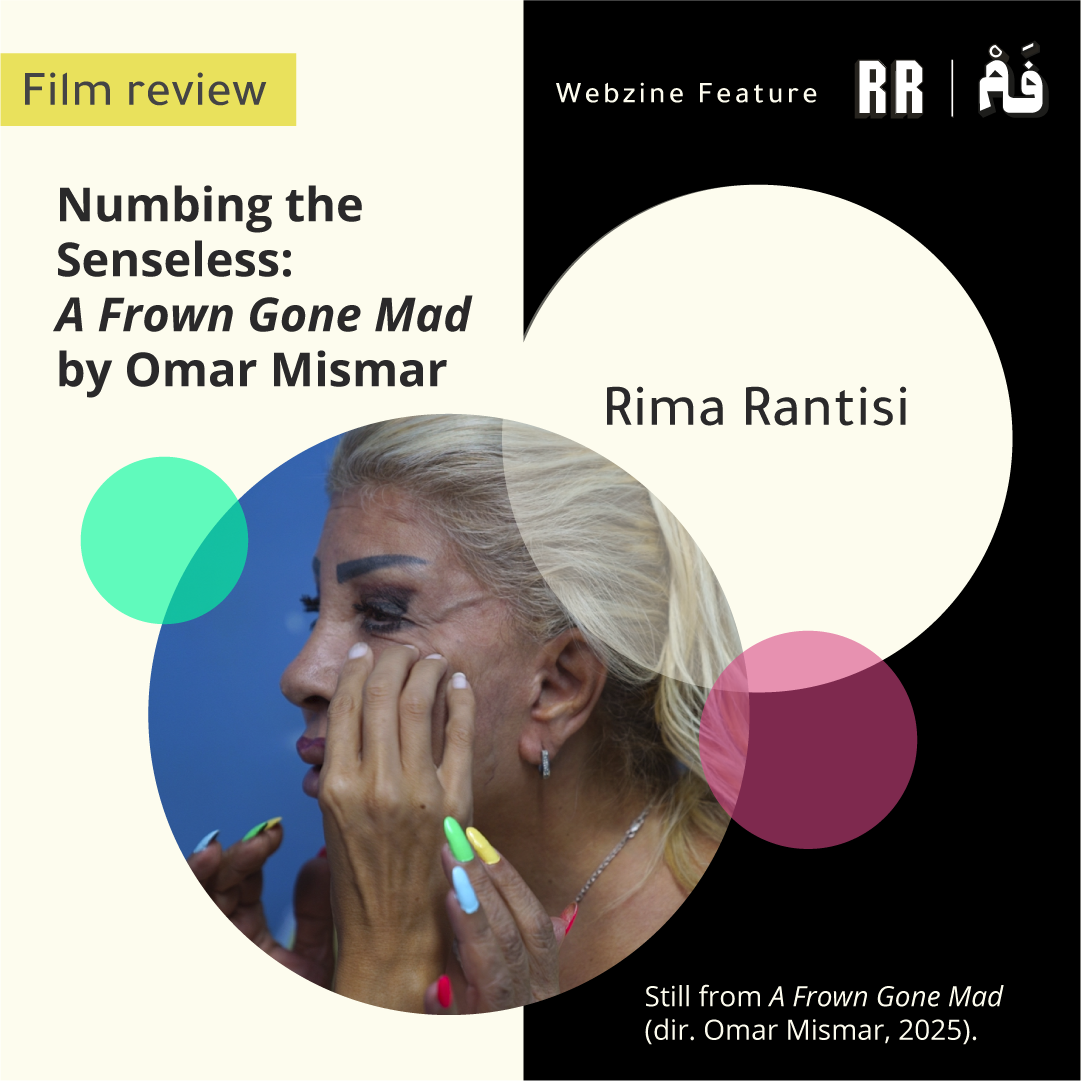
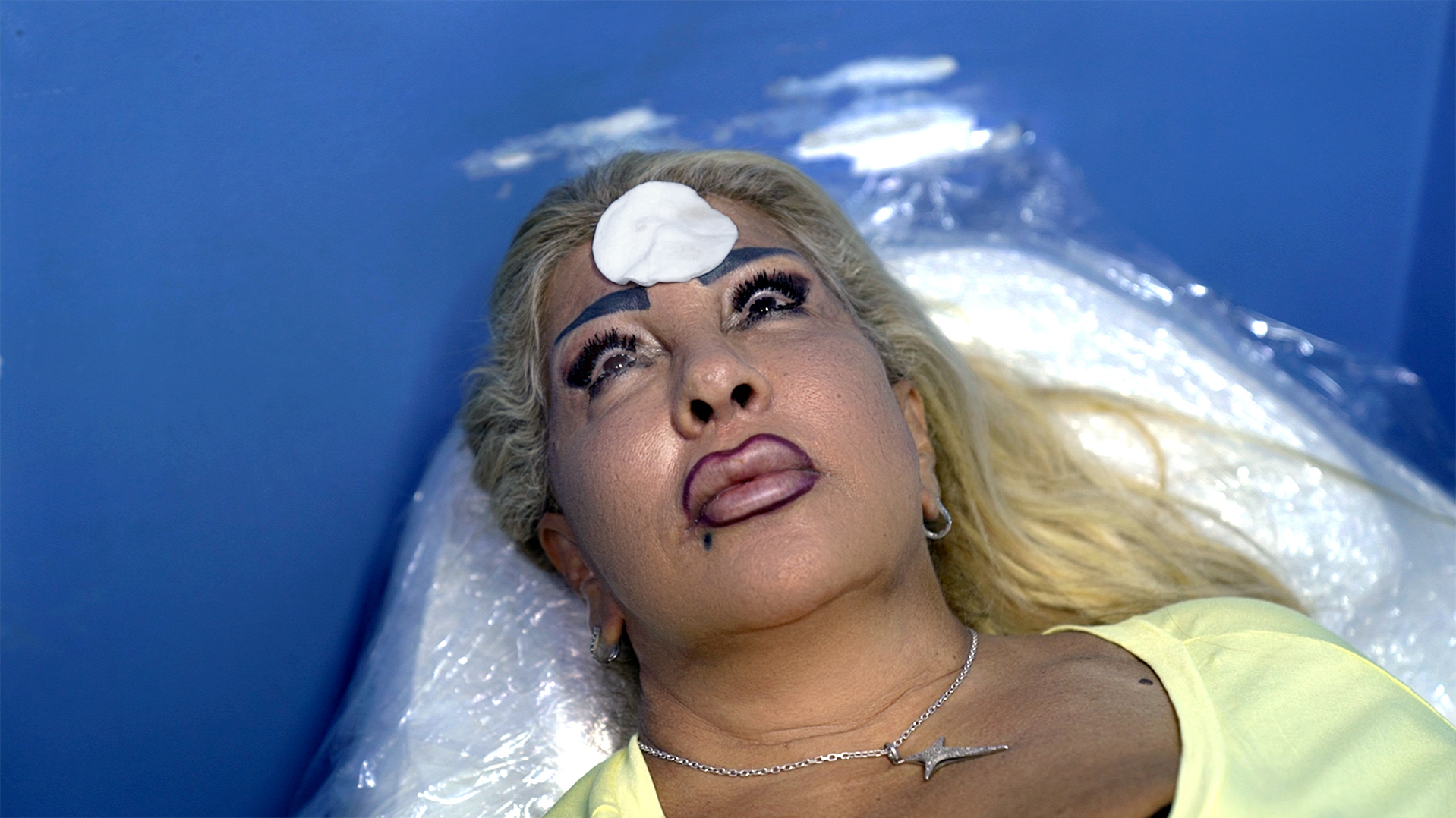
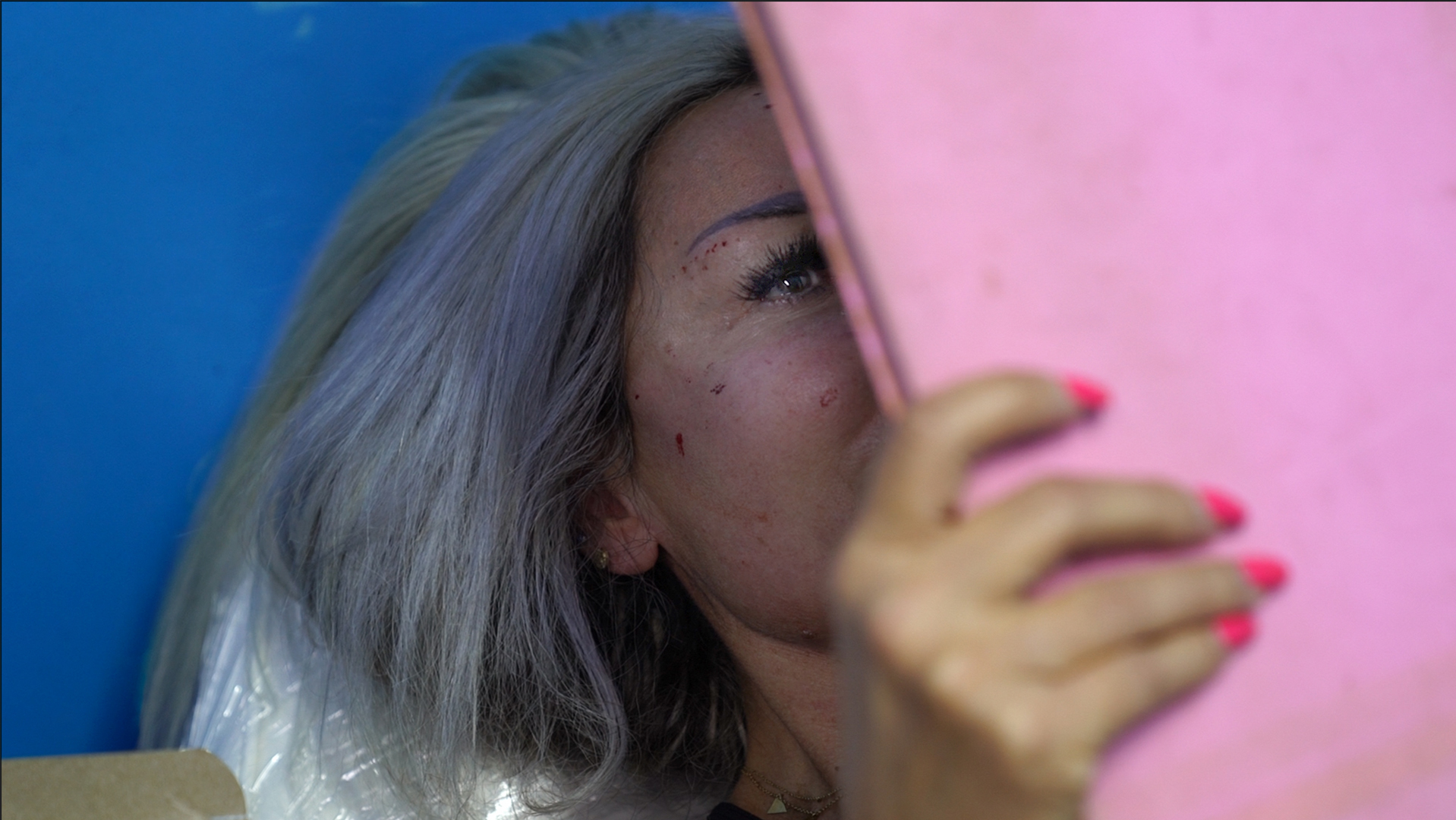
Omar Mismar’s film A Frown Gone Mad (1’11, 2024) will make you uncomfortable as a steady stream of faces, plumped with Botox and fillers, is prodded and needled and left bloodied before the camera. You will be uncomfortable after you leave the cinema, touching your own face, stunned a bit and trying to gather your thoughts. In fact, your discomfort may begin with the promotional poster for the film: a woman’s face, obviously altered by surgeries or fillers or Botox, gazes upward, eyes framed with thickly caked lashes, in the desperate-fearful-hopeful-numbed expression we come to recognize in the men and women who come to Bouba’s chair. Her eyebrows point like Katyusha rockets, her pale puffed lips are traced with a heavy berry liner. One may even call her face garish, like the latest layer in a long, difficult history.
When Mismar set up his tripod in Bouba’s two-meter-by-two-meter clinic in Beirut in September 2023, Lebanon had already endured four years of layered crises including a snuffed-out uprising, a pandemic, an explosion, and a financial collapse – and was reeling from it all in a state of general malaise. The country’s political and social misery would soon deepen with the genocide in Gaza beginning shortly afterward, followed by the war between Hezbollah and Israel in the south. The filming rolls on in this context and engages with this parallel – between the battles outside and those waged on Bouba’s clients’ faces. In Mismar’s gaze, aesthetic pursuit becomes a form of anesthesia: beauty as a buffer against collective trauma.
Amid this backdrop, Mismar grants us emotional access to Bouba’s clients. Through the camera’s intimacy – the viewer is nearly in the clients’ laps as the frame rarely leaves their faces and upper torsos – we are close enough to witness their hanging tears. We are granted access to a deeper psychic layer, where the quest for injected beauty reveals fatigue, pain and rage at its source, and ultimately gives rise to desensitization, a new fresh layer of defense against the mounting onslaught of the outside world. The men and women’s consent, their willingness to be seen in such vulnerability, turns Mismar’s camera into both a witness and a participant in their desire “to be seen,” which offers a sharply framed view in this moment of Lebanese history.
Film still courtesy of the filmmaker
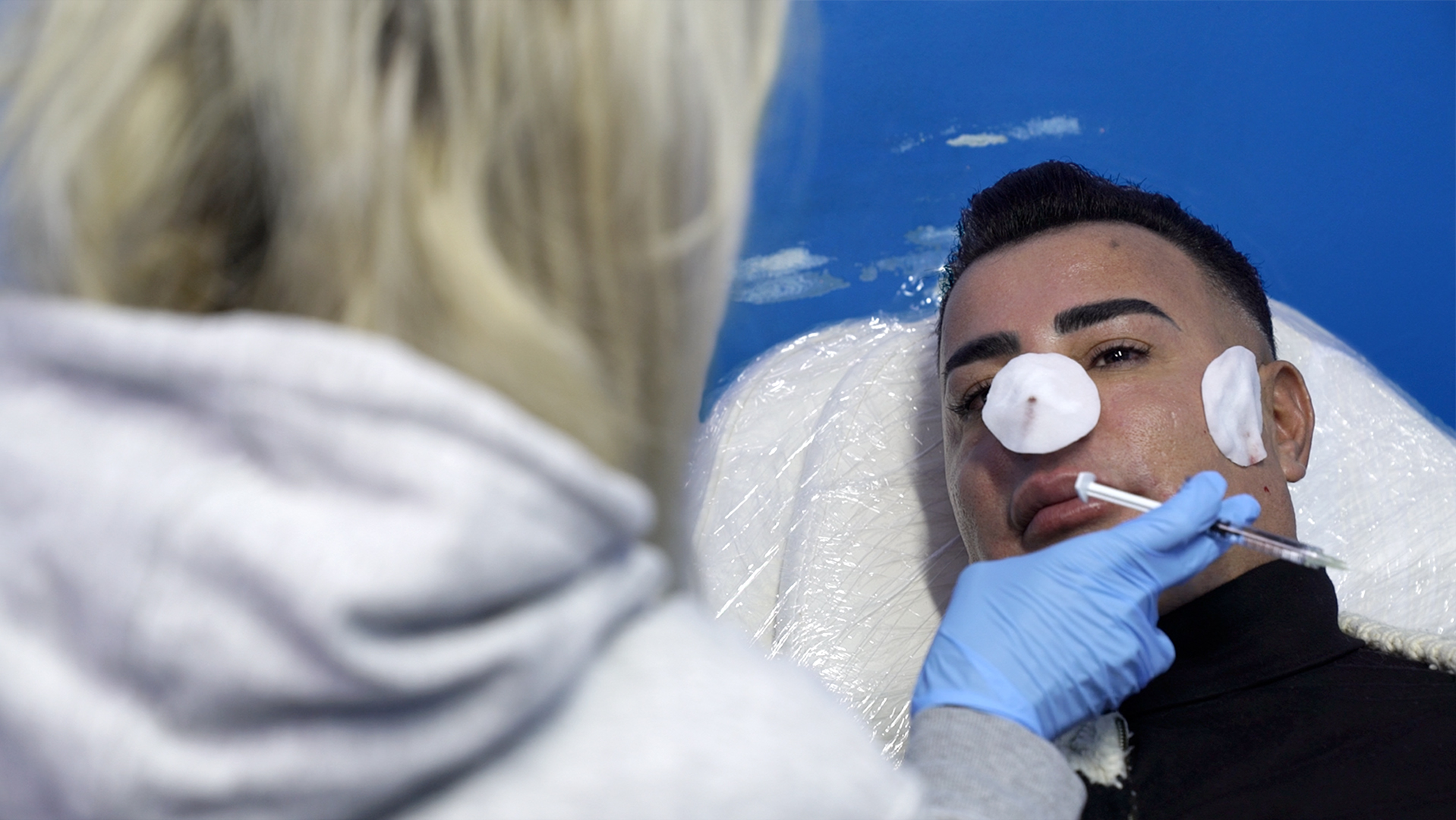
Bouba takes a cotton disc and smothers something that looks like gel onto lips as she asks, “What do we have today?” Her clients point to different parts of their faces: “One here, one here, two here.” They know exactly what they want because Bouba is their girl, and she doesn’t fuck around. She gets right to it, no questions asked. The needle slides into a jaw, a temple, a cheek, a lip. You are not ready for this. Their eyes water. The needle stabs their faces with oafish force. A stab here and here and here. You are reminded of your grandmother coring kusa, stabbing and twisting. Blood dots their faces, drips down while their tears remain stubbornly in their eyes. You can only see the single-gloved hand and the bleach blond extensions of the perpetrator of all this violence. When her work is done, she roughly wipes away the blood and evidence from the battlefield with a dry paper towel. She sends them off mere minutes later with نعيماً. But the customers need one more minute, they’ve lost their breath, they’re coping with their pain, perhaps anticipating their beauty – reminiscent of the lull between catastrophe and recovery.
One woman squirms under her needles, but Bouba reminds her: يللي بدو يتجمّل بده يتحمّل , Those who want beauty must be up to the duty! The woman laughs, tears filling her eyes. The camera remains still, focused on her face, seeing through a current that abruptly stops. When Bouba continues, the woman no longer moves, but takes on a distant stare, numbed. This is just one of the many moments where Mismar shows numbness as subject through form.
Beyond the spectacle of the procedures, Mismar highlights Bouba herself, whose allure anchors the film and complicates our reading of beauty injection-seekers. When Bouba jokes that even salt-water injections would leave her clients happy, it speaks both to the shimmer of new possibilities a new face can offer amidst the wreckage of the country, and to the dependence her clients have come to have on her to erase the pain. Her clients ask: Will there be a wider war? It was a question that we all asked – obsessively checking the news, calling all of our politically savvy friends and family for predictions, hanging onto every word of Netanyahu and Nasrallah. Yet Bouba’s clients seek her for answers. When they lay down and look up at her, they are all hers.
She answers, “No, there’s nothing,” becoming a stand-in for national reassurance, even anesthetizing their anxiety. From the dark of the theater, having lived the war, you might also believe her. But, she explains, in the worst case scenario, like the last time there was a war, in 2006, she had more work than ever, thanks to a new crop of displaced beauty seekers – for whom war does not stand in the way of beauty, or perhaps, we should understand, only intensifies the desire for it.
Building on Bouba’s world, Mismar addresses a topic that has intrigued Lebanese society for years: the pursuit of cosmetic transformation. In 2007, Lebanon became a trailblazer with its infamous bank loans for cosmetic surgery, launched and heavily advertised by First National Bank under the slogan “Beauty is no longer a luxury,” just one year after the 2006 war between Israel and Hezbollah. The loans revealed a ready audience and helped normalize cosmetic surgery as an accessible path to beauty – filled with the promise of social capital. The loan was so aberrant that it even drew scrutiny from outlets like the Los Angeles Times and Reuters. Since the 2019 economic crisis, plastic surgeons have become scarcer amidst the unprecedented mass migration of health professionals, prompting people to seek out less regulated options. Bouba seems to fit this category, both in the casual way she wields her needles and in the cost of a plump, which she shouts to the front desk: barely more than the price of a new blouse from Max.
“Smile. Frown.” She injects. “You’ll continue to come,” she asks softly as she works, “to help me survive, right?”
Mismar interrupts footage of Bouba’s clients with real and doctored ads from Instagram for Bouba’s clinic, in her no-bullshit tone and loaded with war language: “Explosive deals!” “We blew up our prices!” scream out next to images of canons and fireballs. As the film progresses lockstep with the wars, the ads increase in intensity and the deals become even more explosive. In between these, one of the ads claims “If only the beauty loans returned, we would be on top of the world. Here’s our first payment: [middle finger]!” Mismar’s superimposition of these ads collapses the language of beauty and war, commands the pacing of the film, and underscores not only how Bouba’s clinic lays bare the collision of war and beauty but also the economic burdens of Lebanon’s ongoing crises, five years after they started.
Bouba treats her clients – men, women, influencers, restaurant employees, students, old, young, hijabbed – like her own children, as her responsibility. They seem to come from a similar class and from similar pain. She speaks to them like an exhausted mother. Handling their faces like she’s known them since birth. She pats them down and tells them to run off, buck up, and come back regardless of any war or terrible thing that happens outside these four tight walls. You get the sense that Bouba needs them as much as they need her. They need promises, and Bouba needs to get paid.
“I’m dying,” a client says. Bouba replies, “Pay and then die.” The client is speechless, her breath suffocated with pain.
Unlike the typical Lebanese beautician, Bouba doesn’t employ negative speech in her beauty advice (ie. Yiii I will fix your eyebrows). She tells a client, “Your face looks great. You don’t need anything.” This client puffs with pride and looks at Mismar, behind the camera, and tells him, “When I am mentally exhausted, Bouba supports me. Really. Let me tell you something. You see all those people in the waiting room? They don’t only come for beauty and because Bouba has the touch to make them queens, they come in because they’re tired and unhappy, and even though Bouba works on the outside, she takes the pain away from the inside.”
Mismar recognized the poignancy of the moment: Bouba’s needles anesthetize their pain, and the breaking of the fourth wall allows us to see how aware the clients are of the camera – of being seen – and how ready they are to acknowledge, even defend, the person who holds dominion over their pain.
Film still courtesy of the filmmaker
Bouba’s clients were not in the Beirut screening. One wonders what they would have thought of seeing themselves on the big screen. One viewer who left after a few minutes thought the depiction was “degrading to women” as was watching them in such a vulnerable state. But would the men and women featured in the film have appreciated this perspective? Is this repulsion a byproduct of our own stale and biased preconceptions of beauty? Or the denial of the lengths one will go to numb the incessant pain that overwhelms them? One may call Mismar a masochist or sensationalist for placing us before these needles. Half of the theater audience covered their eyes in the first part of the film; but we eventually succumbed, also becoming immune to the pain as the film forces us to inhabit the pain on the screen. When it comes to the ethical question about what happens on the screen, under Bouba’s hand, you wonder: What exactly is so uncomfortable about seeing and momentarily living this pursuit of beauty after all the horror we lived and witnessed in recent memory?
Mismar rejects the stale purity myths inherent in dichotomies equating cosmetic enhancement with low self-esteem and the natural face with self-acceptance. Instead, in the film, a more complex view of beauty surfaces, where the inner voice of the beauty-seeker is imagined, revealing an emotional progression parallel to the pain of the outside world – from denial to surrender, from the fantasy of emotional control to total desensitization. In Bouba’s clinic, the anesthetic and the aesthetic become intertwined – beauty is the path to numbing the pain of the moment against fear and war and economic crisis. A way to numb the senseless.
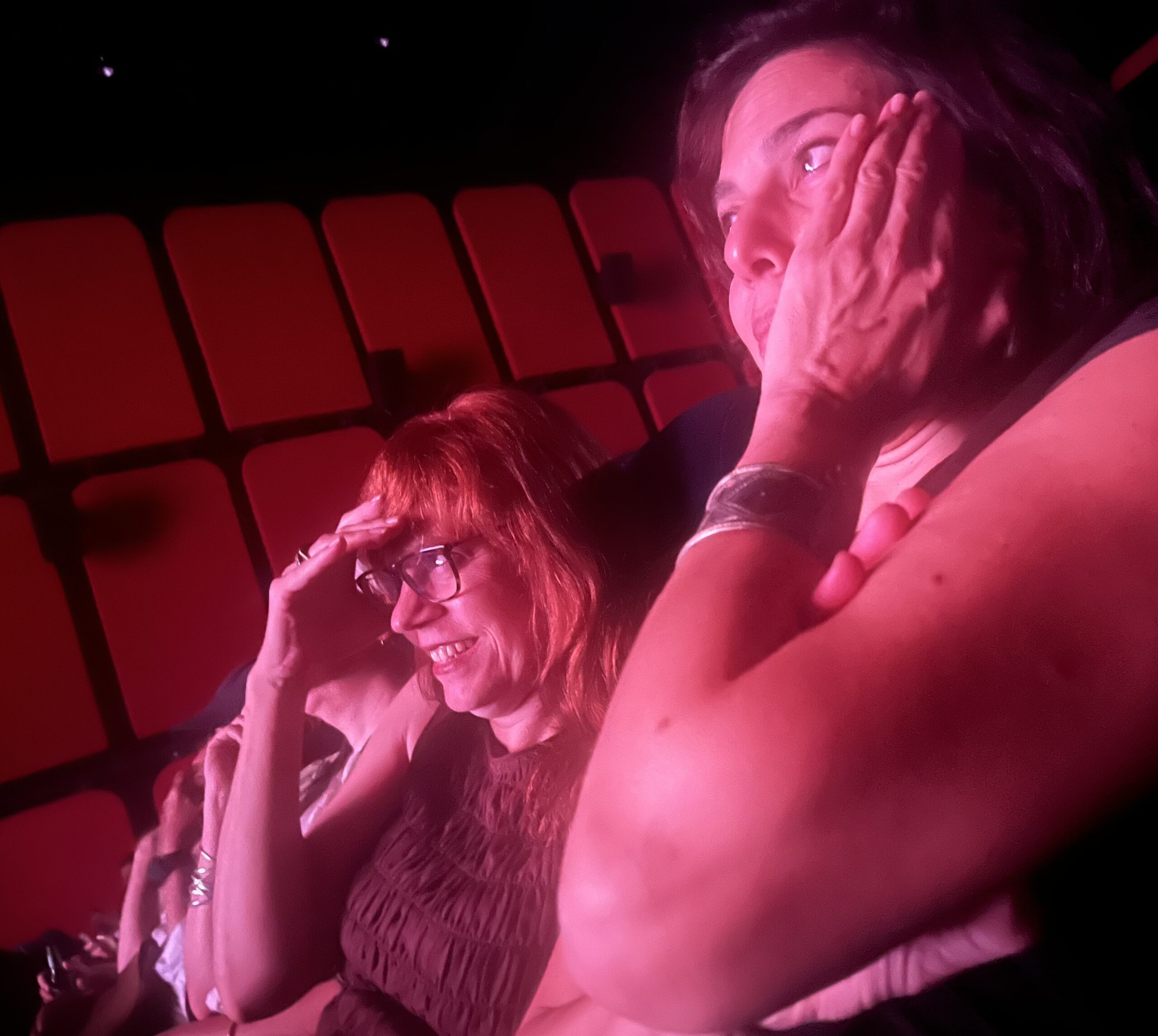
Jana and May and a whole row of squeamish viewers at the September screening of A Frown Gone Mad at Metropolis Cinema, Beirut

Rima Rantisi is an essayist, lecturer at the American University of Beirut, and the founding editor of Rusted Radishes: Beirut Literary and Art Journal. Her essays can be found in the New England Review, Literary Hub, Slag Glass City, Rusted Radishes, and elsewhere. She holds an MFA from Vermont College of Fine Arts and has received literary fellowships from Art Omi, Headlands Center for the Arts, Monson Arts, and Hedgebrook. She is at work on a collection of essays on writing and the liminal spaces residing at the junctions of motherhood/land, fractured histories, and writing.
- Rima Rantisihttps://rustedradishes.com/author/rima-rantisi/
- Rima Rantisihttps://rustedradishes.com/author/rima-rantisi/
- Rima Rantisihttps://rustedradishes.com/author/rima-rantisi/