

I must admit that a sense of dread accompanied me to the screening of Ghassan Salhab’s latest film, Contretemps (Night Is Day, 2024, 345’), in Marseille last summer. The synopsis outlined a narrative spanning from Lebanon’s 2019 uprising, sparked by severe political and economic failures, to the fall of 2023, coinciding with the beginning of Israel’s genocide of Palestinians. For over thirteen years, I had grown accustomed to viewing images and films depicting uprisings in the Arab world and beyond. While I anticipated a fresh perspective from Salhab, a degree of apprehension remained. But as I watched the world premiere of his film in a cinema hall—nearly six hours long with only a brief interlude—I realized how mistaken I had been. No other work by Salhab had resonated with me to this extent. What, then, was the source of its profound impact?
The film’s distinctiveness lies in its self-reflexive engagement in the Lebanese uprising, its aftermath, and the volatile situations in Lebanon and Gaza. In nearly six hours of film time, the audience experiences the collective and the personal experiences merge in a simulated nonidentical chronology. Ultimately, the film’s public events intersect with the filmmaker’s personal events-–an approach often lacking in Arab cinema, art, and other forms of knowledge creation. Salhab’s cinematic project in this film uniquely begins with the unravelling of the Lebanese uprising, using it to elevate the subject-world. By weaving montages of entwined videos and sound recordings, Salhab creates a dialectic that connects singularity and collectivity, forming the film’s body as intricately as nerves constitute the self. Through various analytical detours, this essay aims to explore how Salhab achieves this.
–<>–<>–<>–<>–<>–<>–
For over a decade, I’ve closely followed films and art practices emerging from the Arab uprisings in Tunisia, Egypt, Lebanon, Syria, and Sudan. The uprisings have led engaged artists and filmmakers to address pressing questions about how they should capture these uprisings in image, sound, music, art, and cinema. Such questions have profoundly shaped the aesthetics of documentary and essayistic film and art, giving rise to several distinct approaches.
The first approach is what I call “the euphoric illusion.” At the peak of euphoria, triggered by the early onset of the Syrian revolution, Lebanese artist Rabih Mroué, inspired by Hito Steyerl’s “In Defence of the Poor Image,” focused on the medium in his video lecture-performance piece “The Pixelated Revolution” (2012). Mroué was quick to praise the low-res pixelated images and videos shot by citizens and circulated on social media as “the image of the people.” He contrasted them with the high-res propaganda images produced by ISIS and Assad in Syria, which he dubbed “the image of the regime.” A few years later, thanks to rapid digital technological development, both “people” and “regime” are inundating us with high and low-res images, rendering Mroué’s intervention obsolete in a media-saturated environment.
I identify the second, more revealing approach as “proposals on negativity,” where proponents invoke what has been forgotten or silenced in revolutionary narratives. This method draws from Walter Benjamin’s concept of revolution in On the Concept of History, where he posits that the potentiality of failed revolutions lies not in linearity but in past iterations: “It [the Revolution] is the tiger’s leap into that which has gone before.” Artists, therefore, excavate the archives of the dispossessed, searching for lost hopes, amputated movements, and suppressed methods to speculate on better futures. Mary Jirmanus Saba’s A Feeling Greater Than Love (2018) exemplifies this approach, as frustrations from the Lebanese uprising “rehearsals” in 2015 motivated her to reclaim the histories of labor uprisings preceding the 1975 Lebanese civil war.
Artists can also revolutionize imagery by employing a geopolitical or spatial approach. They shift their cameras from the focal point of demonstrations and street conflicts to marginalized groups distant from the center, as exemplified in Babylon (2012) by Ismael Chebbi, Youssef Chebbi, and Alaedinne Slim; and Je suis le peuple (2016) by Anna Roussillon.
Unlike these interventions, Salhab remains focused on the demonstrations. In his almost six-hour film, he chronicles selected diaries from the surge of the uprising to its aftermath, using his body-camera—an extension of himself— to make the plexus of his body, its nerves and muscles, intertwine the personal with the political, and the private with the public. Salhab remains true to the present moment, finding magic in cinema’s ability to affirm the present without replicating it. His cinema, particularly this film, embodies a “skeptical affirmative”—a negative affirmation that embraces dialectics. This materializes in his juxtaposition of disparate narratives and chronologies with skeptical reflections in his subtitles or exhibited through silent shots of nature, driven by the unsaid and unheard thereby rendering the narratives that emanate from the protests as non-identical takes, altered by the subjective eye.
The film neither chronicles the Lebanese uprising nor Salhab’s personal experience during it. It doesn’t aim to simply inform or produce a linear narrative of the events. Instead, it employs chronology as a specific, skeptical-yet-affirmative tool to explore the uprising’s drama.
What does this mean, really?

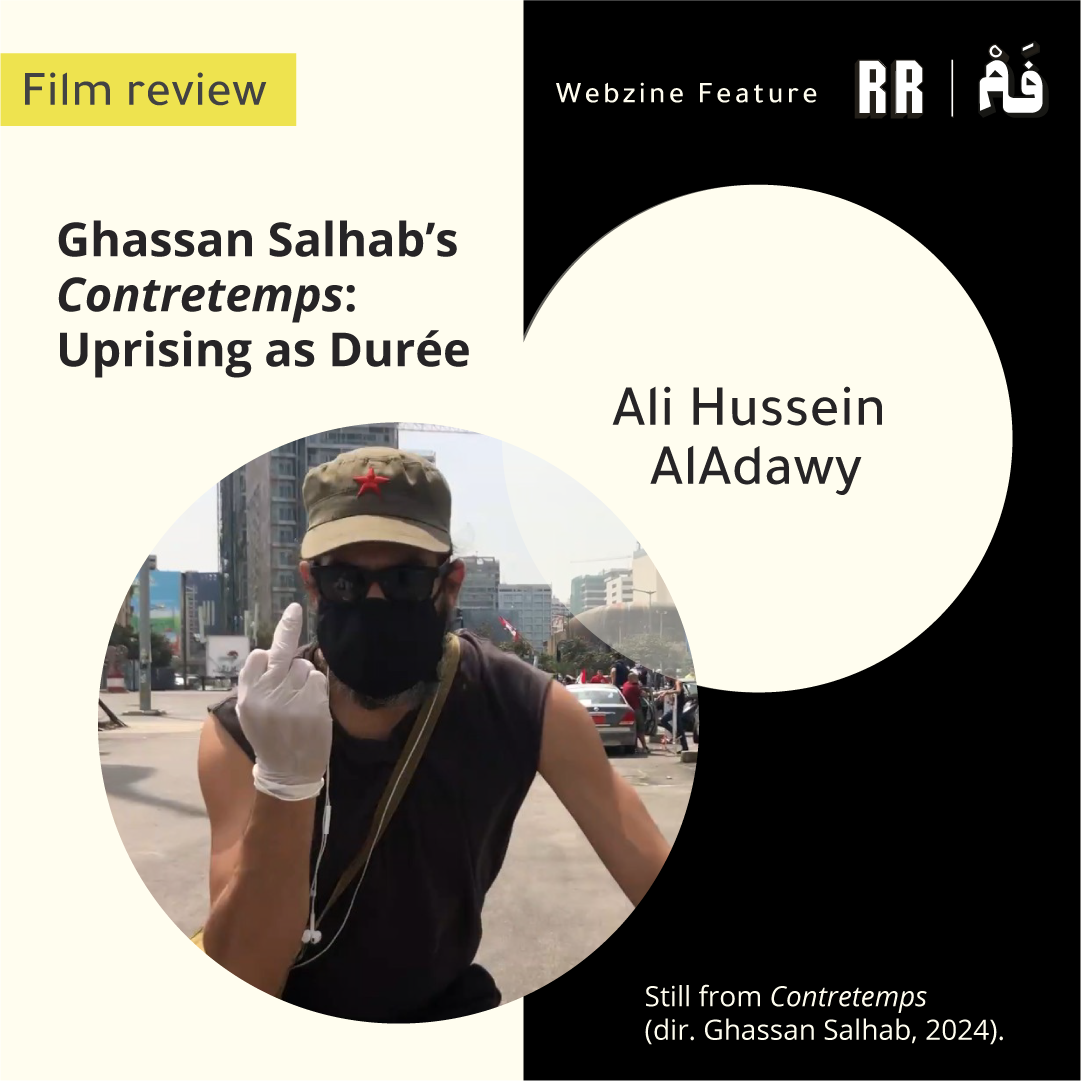
Still from Contretemps (dir. Ghassan Salhab, 2024).
Uprising as a Cinematic Intervention in Temporality
In Contretemps, Salhab’s depiction of the Lebanese uprising offers spatio-temporal experiences. The film opens with a serene shot of individuals (possibly Sudanese migrants) on a beach before transitioning into the uprising’s temporal progression—a practice of discontinuity. Within this, we observe a continuity of diverse lived experiences and their repercussions. Thus, the uprising is experienced not as a dramatic mass delirium, but as a broad, cross-sectional sphere of will.
The film portrays the uprising as a temporal intervention, a continuity within discontinuity, showcasing multiple temporalities: the state’s hegemonic time, the abstract time of economic collapse, and the standard time of the clock, among others. The filmmaker’s body-camera is immersed in the vibrant, round-the-clock marches intimately capturing medium shots. Through signature superimposed images, throngs of people are seen converging on the streets from all directions. This perspective interweaves the personal and the collective experiences of the diverse groups participating in marches, contrasting them with the singular, vulnerable body exposed in front-line confrontations with the ruling regime’s police.
Concurrently, Salhab introduces calmer, self-contemplative shots, observing a ship’s slow approach to the port. (It is later revealed that one such ship carried ammonium nitrate, which caused the 2020 Beirut port blast, disrupting the chronology of events.) From his window, Salhab is sometimes affected by the demonstrations’ chants, and at other moments he remains detached. At times, he captures the demonstrations from multiple angles and along different routes.
The film grapples seriously with both time and cinema, drawing lessons from the uprising. It conceptualizes time not merely as something we react to, but rather as a subjective experience—heavy or light, fast or slow; happy or sad; resentful or ambivalent. This individual experience of time mirrors Bergson’s notion of duration, contrasting with the imposition of a hegemonic, official timeline and the abstract, economic collapse-driven time. In this way, the film adopts a counter-time, a contretemps, actively subverting and opposing dominant temporal narratives.
Authored by means of editing, the images move into three chronological junctures: the initial uprising with its accompanying euphoria and conflicts; the coronavirus pandemic, intimately depicted by Salhab’s mother’s weary hand leading to her death; and finally, the port explosion, which leaves Salhab’s grieving father questioning, “Why did she go before me?” The father’s subsequent death, coinciding with the explosion, silences all inquiries and halts the political movement sparked by the uprising. Such are endings in the Contretemps, predicated on suspended time and losses.
During the pandemic, the body camera captures deserted protest spaces, now vacant and heavy with time. Similarly, night images of neighboring balconies, once vibrant with revolutionary chants, now show prayers for salvation from the epidemic. Following the port explosion and the death of his parents, the time-images become marked with melancholy and rage, expressed through sounds of thunder, wind, sad songs, and heavy rain over scenes of traffic, lightning, and sea and mountain landscapes. This turbulence melds into a feeling of helplessness, triggered by a text message from a friend in Palestine.
“Catastrophe takes care of everything,” the film reads, signaling the onset of the Israeli genocide in Gaza. Amidst the hum of Israeli drones, melancholia emerges as a profound, politically charged, and deeply personal sense of loss, collectively experienced and evoking an overwhelming feeling of helplessness in the face of disaster.
While it’s possible to discern distinct junctures in the film, this doesn’t imply that it consists of isolated, temporally defined units. Instead, chronology is constantly challenged by Salhab’s interweaving of collective witnessing (in public spaces like streets and gatherings) and self-contemplation (from house windows and during car journeys). As Walter Benjamin states, “Although chronological reckoning subordinates duration to regularity, it cannot prevent heterogeneous, conspicuous fragments from remaining within it.” Thus, the chronology in Contretemps‘s montage is a deliberate intervention designed to disrupt linearity.
The uprising and its aftermath, as presented here, resonate with Bergson’s concept of durée—a qualitative, continuous, and internal experience of time, contrasting with the measurable, external nature of scientific time. This subjective temporal experience may explain why Salhab’s film lasts six hours as it aims to capture the living essence of the uprising’s process, where death intertwines with political disillusionment and personal loss. Salhab’s dedication to depicting the durée of the uprising challenges the conventional programming and distribution of films within festivals, cinemas, and platforms, which are often structured around commodified, scientific notions of time. Thus, Contretemps, a self-funded film created from an inventory of iPhone clips, can be seen as akin to Bifo’s description of poetry as “the language of nonexchangeability.” It poetically evokes the durée of the uprising amidst the monstrous global economy of the cinema industry, and it is precisely this tension that makes viewing it a challenging experience.

Still from the film
The Politics of Representation
At the core of Contretemps lies the challenge of representation: How does one film demonstrators while actively participating in the uprising? Salhab navigates this by transitioning from a medium shot of a protest that speaks to our time, capturing his own body within the collective, to various other angles throughout more than half of the film.
The images document a progression from Hamra, a historic center for intellectuals, artists, and activists, through Beirut’s increasingly varied urban areas, ending in Solidere, downtown Beirut’s core symbol of gentrification and sectarian rule. Instead of simple repetition, the images progressively illuminate and deepen the evolving narrative as the uprising gains momentum.
Similarly, sounds evolve from the celebratory chants opposing the corrupt political class, sectarianism, and patriarchy, or expressing solidarity with feminist and queer movements, to the sounds of altercations with police. Salhab’s montage sometimes encourages us to intently listen to protest sounds and visualize the images on a black screen, while at other times, we observe images with no sound so we prick up our ears and conjure the sounds from images. This active engagement immerses us in the uprising, experiencing it alongside him as part of a dynamic collective.
The film confronts us with fragmented images of Lebanese citizens protesting the Central Bank after a major financial collapse, underscoring that any abstract financial hegemony is always rooted in a concrete social context. Concurrently, we see a portrayal of the outdated, patriarchal discourse of an older labor unionist from a previous generation of activists, whom the uprising has just rendered obsolete. This scene stands in stark contrast to a worker’s subsequent testimony, lamenting how union leaders neglected their responsibilities. As such, our experience watching the film recalls mainstream media’s ephemeral interest in both the uprising and those leading it.
As the epidemic spreads, the usually bustling streets and public spaces, once scenes of protest, now lie desolate. They are reclaimed by birds, cats, flowers, and plants, creating a scene where nature, as it transpires in Contretemps, appears to be avenging the violence perpetrated by both the state and protestors.
We then observe images of solidarity and gatherings between humans and non-humans, alongside the sights and sounds of defiant individuals, driven by a spirit of rebellion, determined to protest even from their windows and balconies. We see children playing, solitary care workers, street cleaners, and cat owners. By observing these events, we begin to understand how powerful capitalist systems—both locally and globally—drive crises like climate change and pandemics. These crises are not natural disasters but the result of historical processes in which capitalism disrupts and destroys nature, human lives, and the bodies of those who resist.
Salhab remains outside of offering a discourse, which means he is outside of representation. This explains why the 2020 Beirut explosion remains unrepresentable in the film and in general. Instead, we see the impressionistic, panicked, horrified expression of Ghassan’s cat, followed by a lengthy scene of a demonstration. In this scene, an unnamed woman activist recites the full names of the blast victims, ensuring they are not reduced to mere numbers. This act challenges the sectarian, class, and racial divisions that the victims themselves may have been protesting just a few months prior. Salhab’s cinema, particularly this film, entirely rejects the positions of representation and documentation, opting instead for a mode of skeptical affirmation: that of witnessing. Through his body-camera in Contretemps, he witnesses alongside others the becoming of their uprising.
Toying with Retrospection
Contretemps echoes many of Salhab’s earlier works, including his films and videos as well as his short films. The uprising in this sense performs a political rupture on the one hand, and an opening to revisit his previous works on the other. In No One’s Rose (2000), for instance, we see a car navigating a street, its image contrasted with a voice-over reflecting inner thoughts and feelings, and the sounds of the outside world—traffic and changing radio frequencies—creating a palpable subject-world tension. This tension reappears in Lost Narcissus (2004), where three slow, revealing close-ups of the filmmaker create a generative tension with various world phases and contexts, ultimately showing the failure of narcissism to dominate the scene. What sets Contretemps apart, however, is the way the filmmaker’s singular body-camera, immersed in the collective body of the uprising, merges the individual with the collective, allowing us to enthusiastically imagine the phantoms of Beirut’s dead joining the rebellion against those responsible for their demise.
The engagement with the sense of isolation and alienation in Contretemps evokes that of Terra Incognita (2002). Shot in the 1990s era of suspended civil war, the film features a group of friends, so isolated, so engulfed in their own inner worlds, that they never constitute a collectivity, even when they gather at a concert by the underground electro-pop band Soap Kills and its broody lead singer Yasmine Hamdan.Whereas individuals are atomized and isolated in Terra Incognita, they are entwined in Contretemps. Here and now, we have Sandy Chamoun, a performer turned protestor singing the upbeat popular resistance songs of Sheikh Imam, the iconic Egyptian leftist singer and composer, to a group of friends whose unified bodies are captured by Salhab’s camera, evoking a contemporary image of intimacy submerged in a live collectivity. The transformation that the two scenes, singers, and groups have undergone from Terra Incognita to Contretemps signals a transformation about how the uprisings have ushered in a new rapport with public space, but also friendships.
These comparative iterations prompt us to reflect on how the uprising’s sensory environment alters—or even mirrors—the world’s exploitation, its vampirization. Salhab’s perspective on the uprising prompts us to envision an alternative world, one where survival doesn’t necessitate being an underworld vampire, as he suggested in The Last Man (2006). In Contretemps, with protestors now haunting an archaeological site, individuals can emerge from the underground to challenge Solidere’s oppressive system.
The images in Contretemps explore the tension between birth and death, as seen in 1958 (2009). A pivotal scene depicts the protagonist’s mother discussing the profound joy and transformation she experienced after the birth of her first child (the filmmaker), juxtaposed with a voice narrating the violence of Lebanon’s first sectarian war in 1958. Personal events as historical experiences recur in Contretemps, where the mother’s death during the pandemic is historically framed, much as the filmmaker’s birth was introduced in 1958. Death is presented not merely as an internal, psychic, or metaphysical durée in Bergson’s sense, but rather as a temporal intervention marking the convergence of personal and political loss.
Contretemps delves into novel perspectives on the relationship between image and sound. In Posthume (2007), a collection of media footage and the filmmaker’s own images from the 2006 Israeli war on Lebanon create a tension with the sound, which reflects and conceptualizes varying experiences of time based on different spatial contexts relative to the war. In Contretemps, however, these experiences of loss are not merely demonstrated, they are lived by the filmmaker.
This is not to suggest that Salhab’s oeuvre, with the exception of Contretemps’s first half, is melancholic. That reading is insufficient. I contend that Contretemps uniquely mitigates the central tension between the world and the subject in Salhab’s cinema. This is because the film illustrates how the Lebanese uprising, akin to other Arab uprisings, fundamentally reclaims time. It’s about seizing time—euphorically or melancholically—and making it one’s own, rather than conforming to the dominant temporalities of hegemony, war, and financial abstraction. It seems that a collective, embodied experience of these uprisings propelled a significant cinematic work like Contretemps.
Contretemps thus presents a departure from militant cinema, demonstrating that collectivity doesn’t necessitate opposition to singularity, nor do crowds need to align with the imagined masses of Arab-nationalist totalitarianism. Instead, the film, drawing inspiration from the Lebanese uprising, portrays collectivity through self-reflexive subjectivities. These are desynchronized from hegemonic narratives and differ from a unified national rhetoric. These singular subjects form the diverse tonalities that create the collective melody.

Still from the film
A Video for Cinema
Since the 1990s, cinema has increasingly entered the museum space. More recently, social media imagery, smartphones, and online gaming have gained dominance in the evolution of visual culture. Movie theaters and screening rooms have evolved into communal gathering spots. Simultaneously, some contemporary conceptual artists, including those from the Arab world, have utilized cinema to create symbolic or conceptual pieces reflecting on the challenges of the Arab uprisings. These works, often disguised as narrative films, have found their way into major international film festivals and networks, unburdened by historical context or referentiality.
In Contretemps, Salhab embarks on a contrasting journey. He crafts a monumental cinematic work where the action of the movement-image seamlessly integrates with the contemplation of the time-image. This convergence of action and contemplation holds us captive in our cinema seats for nearly six hours, enabling us to fully absorb the breadth of this movement. Despite its scope, Contretemps is simply credited as “a video by Ghassan Salhab.” Salhab’s proposal seems designed to provoke, and rightly so. To Salhab, the distinction between video and cinema isn’t about aesthetic dogma, medium preference, or the supposed grandeur of cinema over contemporary art. Instead, it’s fundamentally a question of infrastructure.
Historically, cinema has been a collective undertaking, requiring substantial infrastructure, labor, fundraising, and extensive time for scouting, writing, crew assembly, shooting, post-production, and distribution. Video art, conversely, often operates as an individual pursuit, dependent on the artist’s personal dedication, time, knowledge, skill, and specialization. Video artists can leverage smartphones for filming, compile images and archival materials, conduct research, and edit on portable computers. While noteworthy, this individual effort appears less comprehensive when juxtaposed with the scale of cinematic endeavors. This distinction prompts inquiries when a work as monumental as Contretemps is labeled as a video: What are the stakes and the consequences of this classification and for how images are consumed and created?
The Cinema Professions Cooperative, to which Ghassan Salhab belongs and which is credited in the film, emerged from the uprising with a clear message: For cinema to maintain its experimental, self-reflexive, singular, and imaginative qualities—essential for preserving the uprising’s methodology and spirit—it must remain a collective effort. This necessitates leveraging various art and cinema economic infrastructures to foster autonomy, create worlds of self-reflexive futurity, and contribute to the internationalist, grassroots project of emancipation against any hegemony.

Ali Hussein AlAdawy is a curator, critic, and researcher specializing in film, moving images, and urban contemporary art practices. His work engages with global critical theory and modern cultural history. He has curated numerous film programs and exhibitions, including Labor Images(since 2019),Serge Daney: A Homage and Retrospective(2017), andHarun Farocki: Dialectics of Images(2018). He co-curatedThe Art of Getting Lost in Cities: Barcelona & Alexandria(2017) andBenjamin and the City(2015). A founding member ofTripod, an online magazine for film criticism (2015–2017), he also contributed toTarAlbahr, a platform for urban and art practices in Alexandria (2015–2018). He holds .an MA from Bard College, New York, focusing on the intersections of human rights and contemporary art.
علي حسين العدوي قيّم أفلام ومشروعات فنية بحثية وناقد وباحث ,يحرر أحيانا ويكتب في أحيان أخرى.
- علي حسين العدوي | Ali Hussein AlAdawyhttps://rustedradishes.com/author/%d8%b9%d9%84%d9%8a-%d8%ad%d8%b3%d9%8a%d9%86-%d8%a7%d9%84%d8%b9%d8%af%d9%88%d9%8a-ali-hussein-aladawy/