





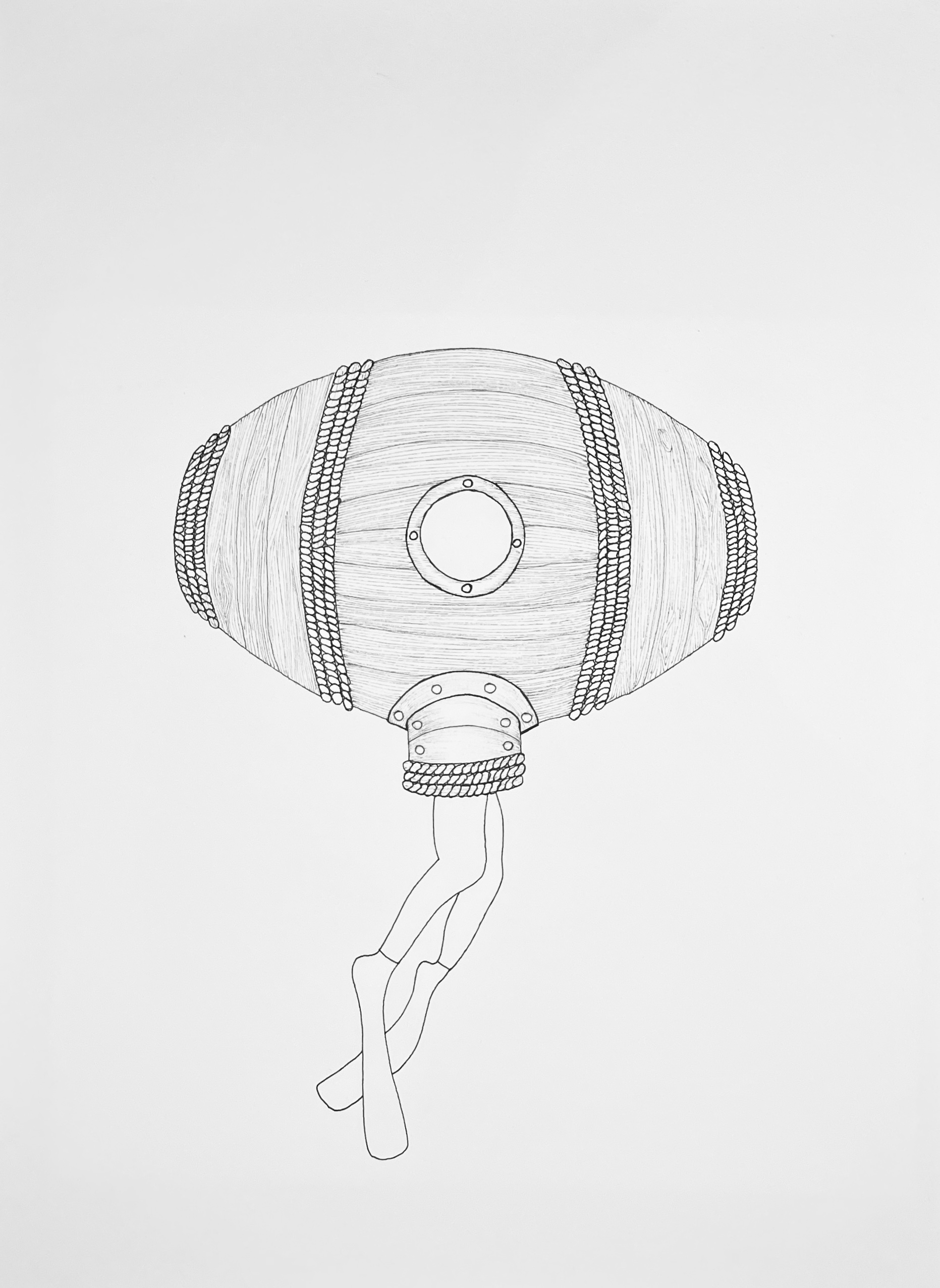
Mohamad Abedlkarim, Floating Limbs: The Case of Evolution, #8.
Pigment and ink on cotton paper, 49 x 35 cm (2022/2024)
[1]You can translate the word muʿallaqah as a hanging ode: A poem so prized it was hung on the walls of the ka’bah, at least according to legend. ʿAntarah, born an enslaved princeling, is the author … Continue reading Muʿallaqat ʿAntarah
My poet trades a cleaver for a needle:
His finger and thumb make an eye, his needle
an emphatic tongue. One hand hovers,
another runs rivers over a well-patched coat.
My poet, kill-weathered hand and bent,
ready knee, pinning light with a palm spread wide,
beseeching fabric, limning nothing,
he takes old scars for his own seams. My poet,
slurring, humming, drunk on a sound—
a plea for prayers—he says his poets left nothing,
nothing in need of patching.
What a blessing it is, he tells me.
Hail, nothing! Speak, nothing!
Then, the give of a chance under his fingers,
and the needle tilts.
Doaa Atamna is a PhD candidate at UC Berkeley, working on her dissertation in Classical Arabic Poetry. When she is not reading, writing, or translating poetry, she paints roses and plays the piano.
Footnotes:
| ↑1 | You can translate the word muʿallaqah as a hanging ode: A poem so prized it was hung on the walls of the ka’bah, at least according to legend. ʿAntarah, born an enslaved princeling, is the author of such a poem. His freedom he earned in battle, a glory he would relive in tormented verse. The first line of his muʿallaqah reads:
هل غادر الشُعراءُ من مُتَرَدَّمِ أَم هَل عَرَفتَ الدارَ بَعدَ تَوَهُّمِ Have the poets left anything in need of patching? Or did you recognize the abode after long-imagining? |
|---|
