




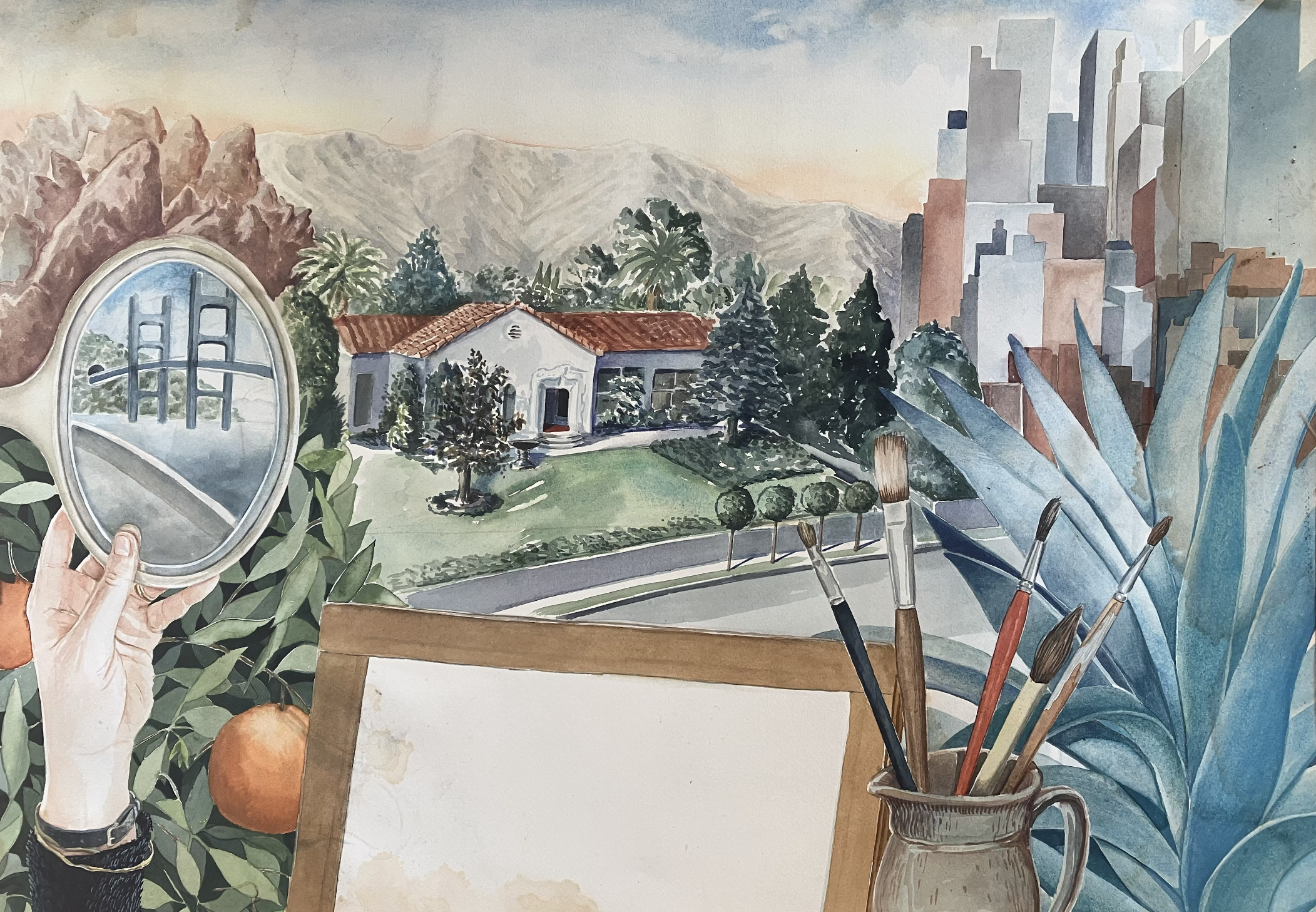
Painting the Past, watercolor on paper, 22” x 30”
I’m thirty-two, living in San Francisco, and nearly done with my MFA program when the subject of my watercolors takes a turn. As an escape from the large figure paintings I’m developing for my thesis, I start painting watercolor still lifes, though I keep them to myself, certain they’re too quiet for the critical exposure of a grad critique. The watercolors are composed of objects from the studio, arranged on the worktable before me, something I’ve never done before. I don’t worry about what they mean, and it’s refreshing not to toil over ambitious work, so I continue, following where the images lead.
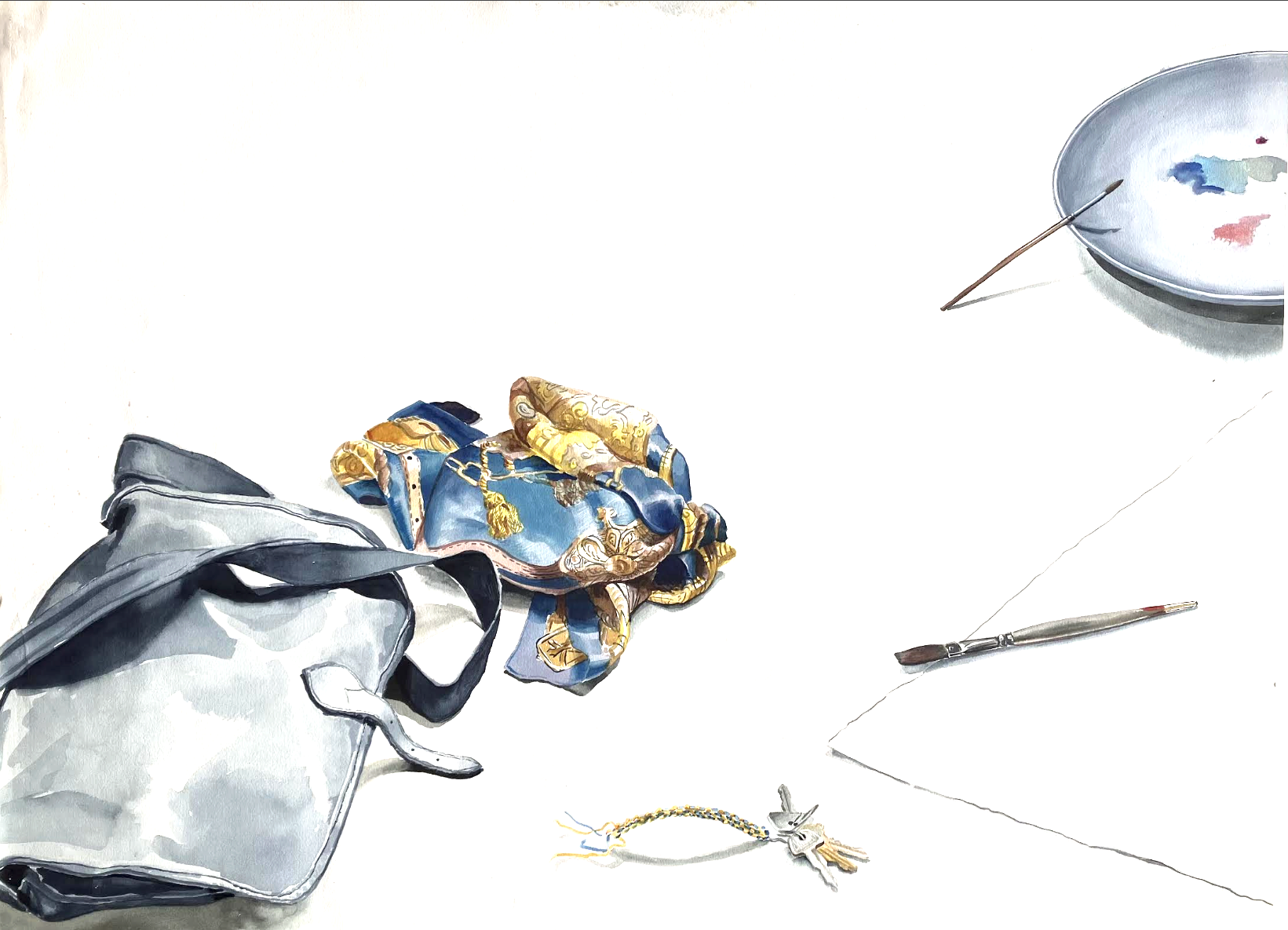
Untitled, watercolor on paper, 22” x 30”
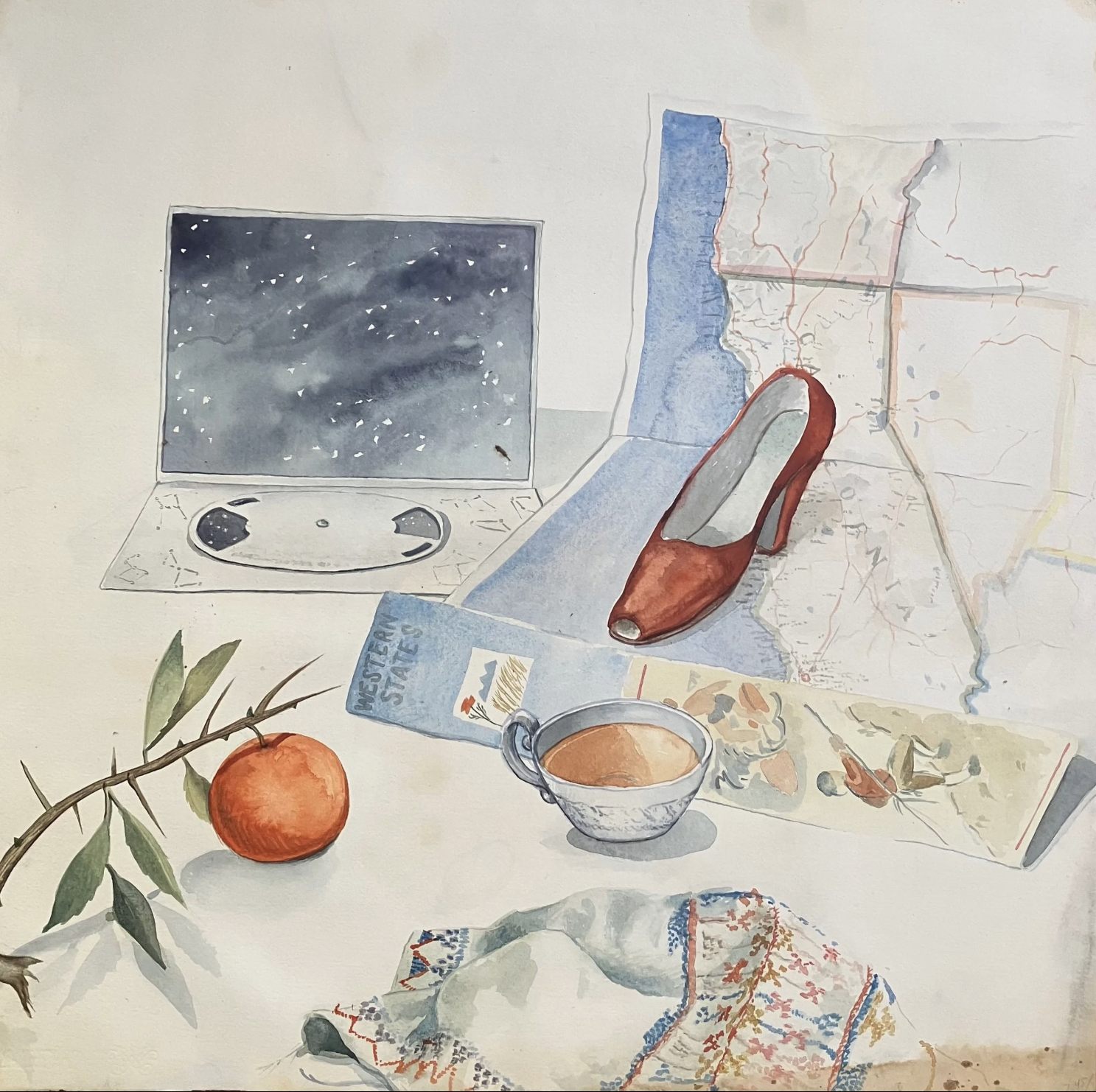
Still Life with Map, Shoe, and Tatreez, watercolor on paper, 26” x 26”
What surprises me is the stories they tell. I paint what seems like a random arrangement of a California road map, a favorite shoe, and an orange alongside an unfinished piece of tatreez. In the proximity of these personal objects—the shoes, the roads of the state I’ve grown up traveling on, and representations of culture and place, I see a story of uprootedness, though one I don’t fully understand yet. In another picture, I paint my shoulder bag, the scarf I’ve just pulled off, and my keys set alongside a painting in progress—and life’s ordinary articles suddenly intersect with artmaking. The compositions blend the personal with invention, and I’m drawn to watercolor’s immediacy, the ease of testing this new ground. With each composition, it becomes apparent the pictures are an investigation, a search for a more personal subject.
I’d married young, and the marriage had recently ended. It was an uncertain time in both life and art. Beyond the degree I hoped to earn, the future was unknown, and the objects in my watercolors occupied a similarly undefined space. These were personal effects arranged on a work table, with only the paper’s white background as context, painted in a basement studio in San Francisco by a woman unsure of the path of her life. At the time, the ambiguity of an undefined space interested me, but it’s also true I left out the complicated elements of background, the objects’ environment, the setting. Seeing the pictures now, the missing context echoes both the ambiguity of my life at that time, and suggests the complicated narrative of my personal history.
❂
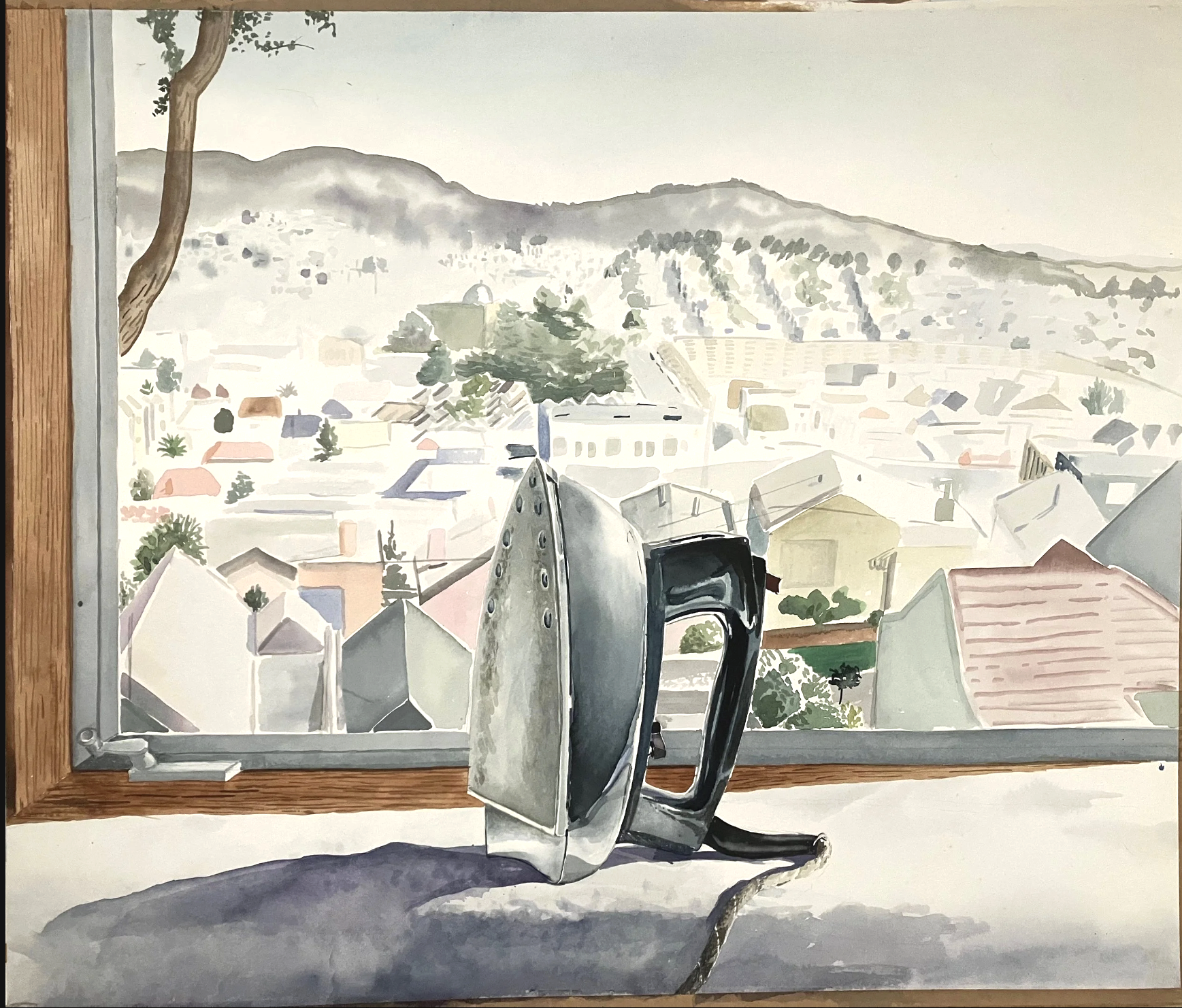
San Francisco Domestic Scene, watercolor on paper, 24” x 30”
At thirty-two, an age when I might have been past questions of personal identity, I’d yet to sort out the hybrid nature of my family story. My parents’ brief, bicultural marriage was a rarity for its time and was perhaps among the reasons they never spoke about it. My father was the eldest son of Levantine Arabs and my mother the only daughter of Ashkenazi Jews, and as second-generation children of immigrants, both navigated dual-culture conflicts and rejected the traditions they’d grown up with. They met one summer at an art camp in upstate New York. My father was newly discharged from the army, studying art on the GI Bill, and my mother was still in high school. They quickly bonded, and despite her parents’ objections to the mixed marriage, the year she turned eighteen, they were married at the courthouse in Woodstock, New York.
It was 1950, and from the start, their marriage was defined by cultural difference. My mother’s parents were lifelong New Yorkers who spoke Yiddish and were active in the Jewish community, though by the time I was born, they rarely went to synagogue, and while they no longer kept kosher, still counted multiple sets of milk and meat dishes in the cupboards. My father’s Arab parents lived for decades in Brooklyn’s Atlantic Avenue district, where on the blocks between Clinton and Court the storefront businesses were owned by an influx of immigrants from Syria, Lebanon, and Palestine. The year my parents married, my grandfather, a baker and confectioner, retired in Los Angeles. A few years before, on the advice of a friend, he traveled west to see for himself the foothill community of Altadena. With its orchards and backdrop of mountains, the friend claimed, it was just like Damascus.
For my sister and I, the family story was complicated, difficult to explain, an outlier we had no comparison for. When asked about our heritage, we’d say only We’re Jewish and Middle Eastern, describing our Arab side in the parlance of the seventies. Our blended family culture was a bewildering contrast of traditions, languages, faiths, and acculturation. Visiting my Jewish grandparents in New York, I didn’t understand the Yiddish they spoke, or the stories in the Haggadah we read at Passover. I wandered the exotic terrain of seventies-era Manhattan, with its snow and subways, wanting to connect to the city where I was born, but feeling like a stranger. In Los Angeles, where my Arab grandparents lived in a close-knit community of Lebanese and Armenian immigrants, I was never taught the Levantine Arabic they spoke at home, and though the conversations were rarely translated, I grew accustomed to hearing them, and to the solitude of my grandparents’ home-centered life. My sister and I were still young when our parents divorced, and in the years after, we were the links who moved between households. We lived in two cultures, but the complexities of who we were was never explained. By the time the marriage ended in 1960, the story of the rebellious art students who crossed cultural boundaries to marry was a story no one wanted to tell.
Yet there are patterns in the family story, and they’re easier to see now, these echoing stories of mixed identity and place. My Arab grandmother was the daughter of a Syrian mother and a Turkish father, and their bicultural marriage at the turn of the 20th century was unconventional for its time. The blending carried over to my father who grew up in Brooklyn, a third culture kid before the term originated. And it’s my father, who grew up between the old and new worlds, rather than his immigrant parents, who struggled with finding a place he belonged. He could be brooding, and reclusive, preferring to freelance from the house in the Los Angeles hills he lived after the divorce, and when the house was destroyed in a canyon fire, the years that followed were unsettled ones. He moved between places—southern California, El Paso, the Mojave—never finding a place to equal the one that burned. I think of my grandfather, who left Damascus for the US as a young man rather than be conscripted into the Ottoman Army, who quickly put down roots in Brooklyn—a business, four children, a community. Forty years later, he found roots again, in Altadena, in a house reminiscent of the home he left, with fruit trees and mountains in the near distance, and a patio off the garden like the courtyard houses in Damascus. My grandfather was lucky to twice find a fit of person and place, a setting he could claim as his own. My father never did, and so far, neither have I.
In the studio, the matter of setting made its way into the watercolors. Where were these still lifes situated? What kind of setting might encompass both the personal story and artmaking? I had questions, and the only way I knew to investigate was by means of place.
❂
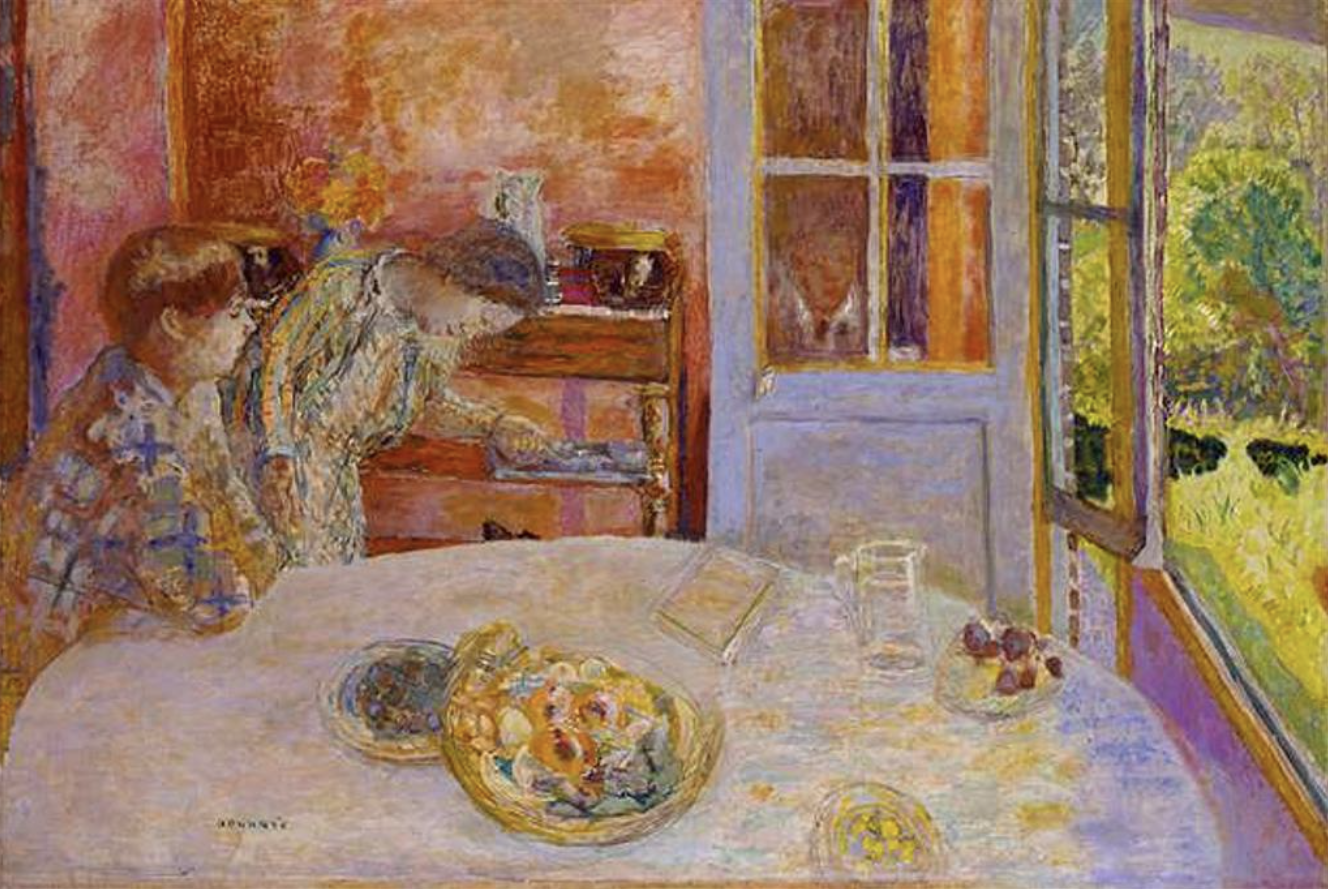
Pierre Bonnard, The Dining Room, Vernon, c. 1925, collection Ny Carlsberg Glyptotek, Copenhagen
The term still life comes from the Dutch stilleven, and translates to “quiet life.” Traditional still lifes often center on quiet spaces—domestic, private worlds where objects serve as a means of reflection—a vehicle for light, form, and the artist’s technical skill, and a way to capture life, a commentary on time and memory. In the 17th century, a sub-genre of still life known as vanitas emerged, a painterly version of memento mori in which objects are allegories for time, mortality, the transience of pleasure. A vanitas still life can include snuffed candles, wilted flowers, a glass globe, butterflies, an hourglass, sheets of music—all meant as contemplation of the temporary. Yet a still life doesn’t need these to suggest the fugitive. Any subject captured in time is a depiction of a moment that is already gone.
I think of interiors as still lifes that have broadened their scope. The Intimist pictures of French Post-Impressionist Pierre Bonnard have the considered arrangements of a still life. His domestic settings—a breakfast table, a library, the bath—are personal in the same way. A carpet, the slant of light in a room, the arrangement of objects tell a particular story of place. When a figure enters the composition, in a woman at a dressing table, or seated with a book, the story becomes more complex. Who is the figure in relation to the space, and to the viewer? In Bonnard’s late interiors painted at Le Bosquet, the artist’s small house in the hills above the Mediterranean, he incorporated figures, primarily his wife, Marthe, in transitional spaces. Stepping out of the bath, setting a dish of fruit on a table, leaning toward an open window with the sea in the distance. The close attention he gives his scenes is rooted in place, in their life at Le Bosquet, and the final years of his life in the Alpes-Maritimes region of southern France.
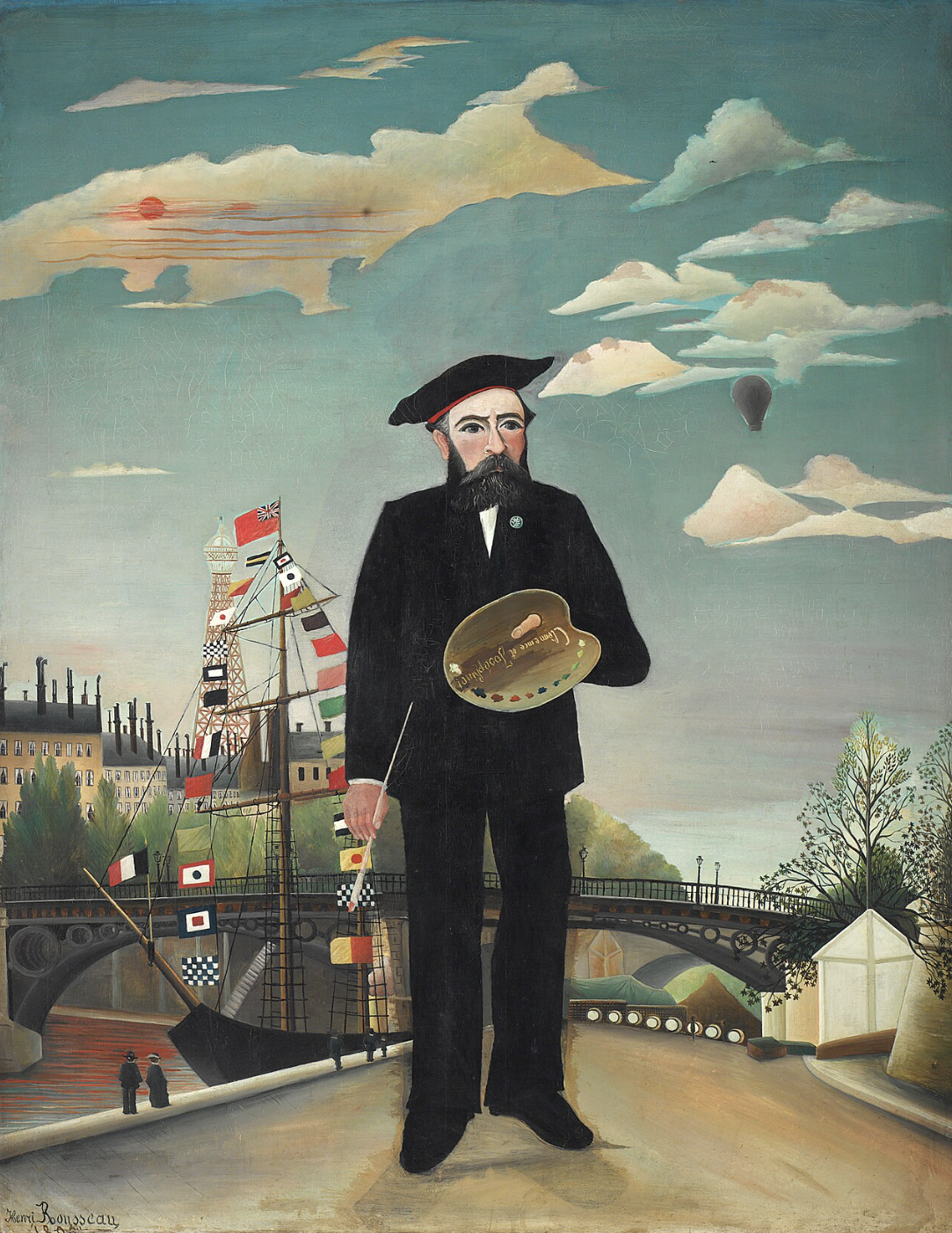
Henri Rousseau, Myself: Portrait-Landscape, 1890, National Gallery Prague
Thirty years earlier, the self-taught Henri Rousseau painted a hybrid self-portrait, Myself, Portrait-Landscape. He was forty at the time, a toll officer in the city of Paris, and the self-portrait was one of his first exhibited works. The picture’s title was meant to challenge the fin de siècle division of portrait and landscape, and accordingly, Rousseau incorporated personal references of the self and landscape. The palette he holds bears the names of his first and second wives, Clémence and Joséphine, and the landscape in the distance, of Paris, includes the newly constructed Eiffel Tower, perhaps a signal that although the artist is still unknown, he’s claiming his place as a painter of modernity.
❂
The unexpected turn in my still lifes comes in the third and final year of grad school. I paint a hybrid still life and eventually title it Painting the Past. It’s a sentimental title I wouldn’t choose now, but at the time, with my marriage over and the end of my grad work in sight, the past took on a new importance, a kind of roadmap for life and art. In hindsight, the subject of the past seemed a natural one, given the future was as open and dynamic as it would ever be.
Painting the Past is a still life, a landscape composite—and with the inclusion of the hand and mirror—it becomes a self-portrait. I begin as I had with the first watercolors, using objects from the studio: a blank sheet of paper on a drawing board and a pitcher of brushes. The hand with its mirror comes next, then the reflected image of the San Francisco-Oakland Bridge—a signal of where I would live next, across the bay. Already, the picture is telling a story.
From there, I work intuitively. At the center, I paint my Arab grandparents’ house in the foothills of Altadena. I paint an imagined skyline of Manhattan, similar to the one visible from my grandparents’ apartment, then the rock formation of Castle Crags in California’s northernmost county, Siskiyou, the first place I live upon leaving home. I add the detail of a stemless agave, called a century plant, a specimen ubiquitous in the Bay Area, the place I land in my late twenties to study at the San Francisco Art Institute. The locales are collaged within the picture’s frame, disparate places with no visual or geographical connection beyond my own history, and yet, both then and now, the composition feels whole.
Decades later, looking at this hybrid portrait/landscape, with its illustrative style, its mix of the observed and imagined, and interest in the personal over the formal, I think of pictures like Rousseau’s, driven by the straightforward need to tell a story. I must have understood how idiosyncratic the picture was, because I never shared it with my graduate painting cohort. The picture referenced none of the era’s aesthetic and critical issues, and so, unprepared to defend it on formal grounds, and reluctant to explain the complicated biography behind the imagery, I kept the work to myself.
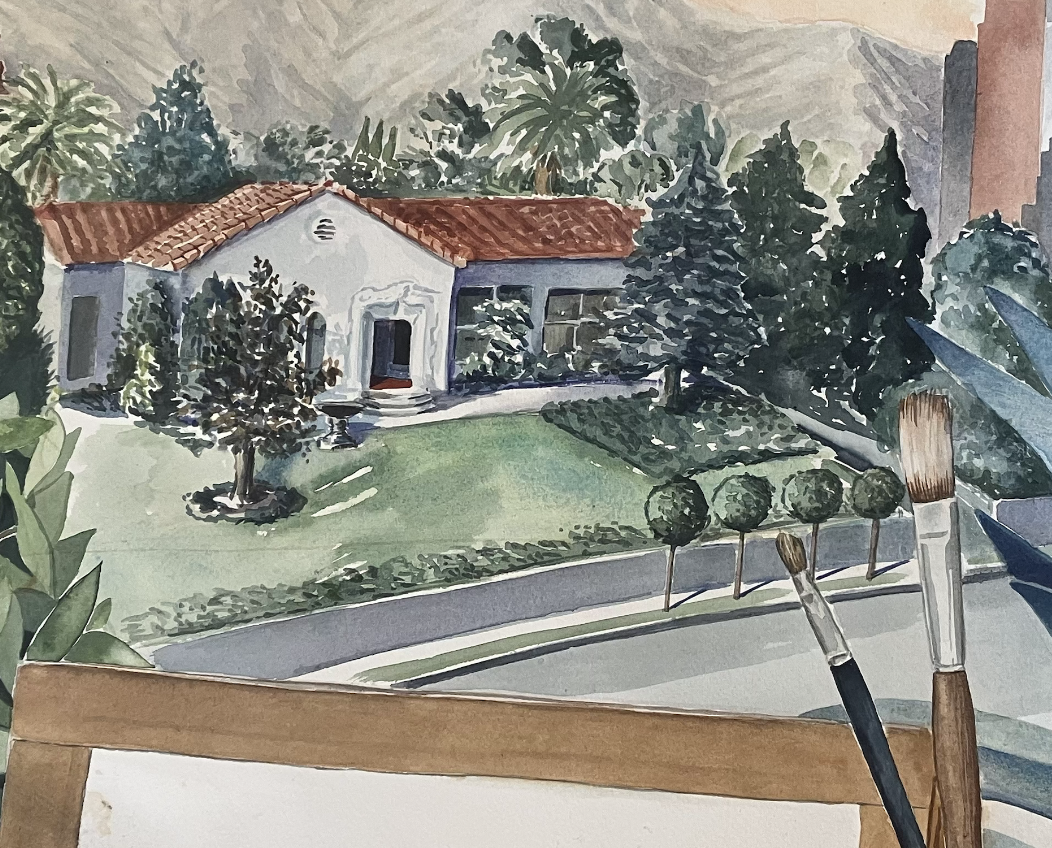
Painting the Past (detail), watercolor on paper, 22” x 30”
Settings are static. Places are changed by time, by disaster, by the change that takes place inside us. In the watercolors of my thirties, I took the permanence of those settings for granted, though within a decade they would change. With the deaths of my mother’s parents and the sale of their family home, our visits to New York became infrequent. I finished graduate school and left San Francisco for the East Bay where I remarried and my husband and I raised our daughter. The house in Altadena was sold after my grandmother’s death, though its sale, and the succession of owners over the decades didn’t lessen the connection.
In 2025, when the Eaton Fire destroyed over 9,000 structures in Altadena, the house was one of them, and a year later, its place at the center of Painting the Past carries a different meaning. The connection is more difficult to define than a hybrid family history. There is the memory of places we know, and the memory of places that are gone—two very different ways of thinking about place.
How many times after the house was sold did I watch it from the street and find it essentially the same? There was the familiar red tile roof and arched front entry, the facade of south-facing windows, the magnolia to one side and the deodar at the other. But after the fire, after the hazardous material and structural debris were removed, the burned trees uprooted, and the lot excavated, the site and its terrain were changed beyond recognition, beyond the reach of memory. And now, the meaning of the montage in Painting the Past has changed. The picture carries a loss it didn’t when it was painted, and the personal story so important to me then now seems secondary.
The still life I painted hoping to merge a fragmented story, to unify a bicultural narrative, has changed over the decades. The place at its center is historically gone, and yet, as with all still lifes, the image captures a singular time and place. The genre meant to memorialize life, the ordinary images of our days, leaves them frozen in time, yet the life outside the picture continues to change. The world shifts, places disappear, and the artist changes, too. With time, her view of the picture is altered, and the images take on a ghostly quality. That seems the trick of still life, not mimicking outward reality with sleight of hand, but to show us apparitions that are no longer there.
❂
In The Triggering Town, the poet Richard Hugo writes, “…most poets write the same poem over and over,” an interrogation driven by questions that can’t be easily answered. Nobel laureate Orhan Pamuk, who annotates his watercolor studies with reflections and notes on plot and character, puts it a slightly different way, in the context of memory: “If you paint the same landscape all the time—which I do from my New York or Istanbul window, looking at the Hudson or Bosphorus, or the landscape of your table—then you begin to write about, in a way, time.”
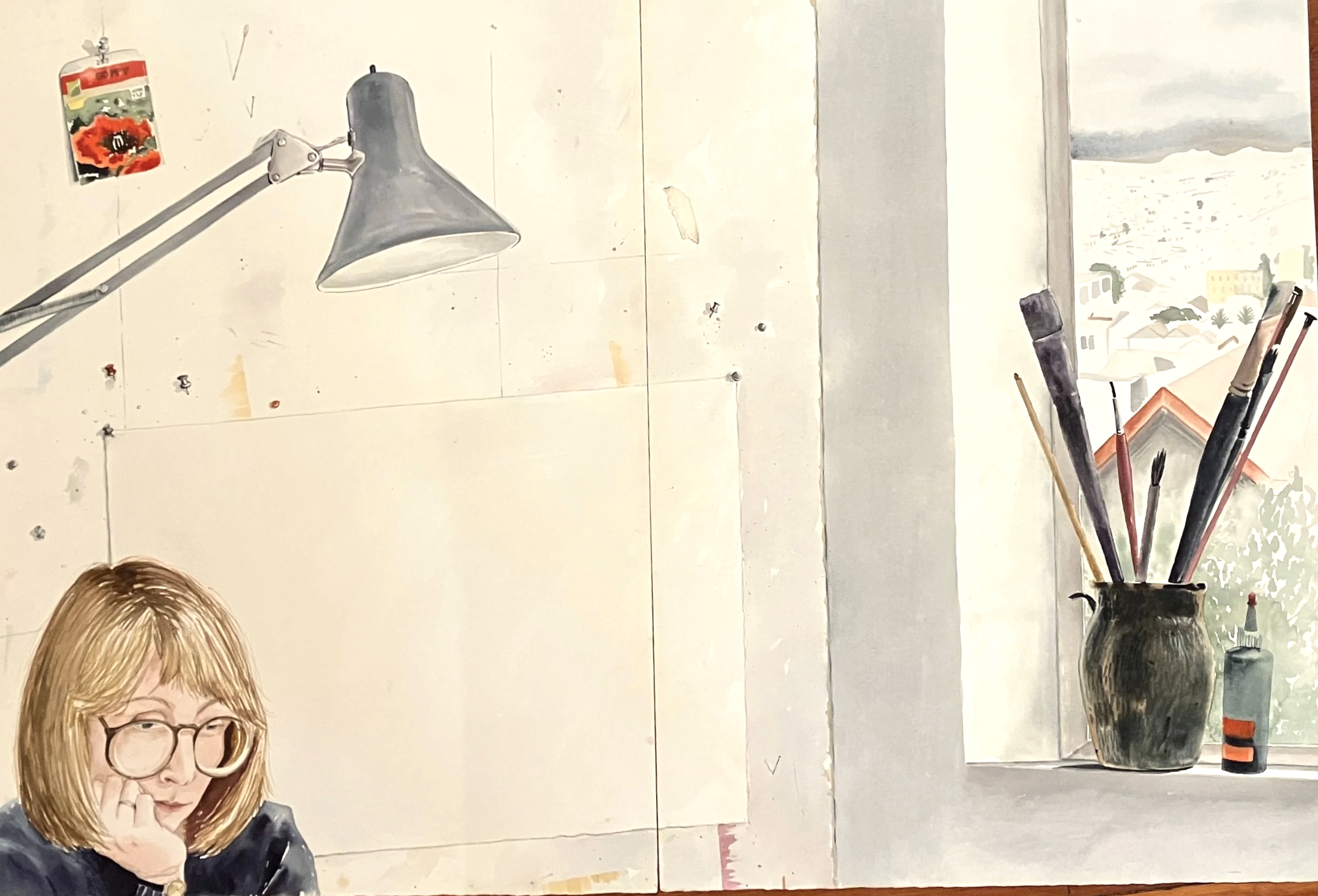
Self-Portrait in the Studio, watercolor diptych, 30”x44”
In the years I made visual art, images of place ran like a litany. Los Angeles, New York. The Shasta-Trinity mountains of Siskiyou County. And yet, visual images of place, no matter how clear in memory, can’t explain cultural inheritance or the complexities of family history, and it was this limitation in the decade after graduate school that led me to stop painting and begin to write. Writing fiction, and later, nonfiction, brought a more direct form of inquiry, using language and narrative to examine tensions of person and place, and how time and change shape character.
In prose, I could examine my subjects’ thoughts, feelings, words, deeds, in dramatic action and narration, which, much like light and shadow, renders a subject in contrast to its ground. Though where a still life is just that – still – stories are by nature dynamic. A narrative can describe, for example, how it feels when a character is an outsider, and the changes that come with separation from the setting she knows; dramatic action can describe the nuances of her thoughts and feelings, and how they can shift over time. My collaged self-portrait of place could telescope time but it couldn’t describe how influences in opposition coalesced to a third way of seeing the world, one unlike that of my grandparents, or my parents. As a student of fiction, I quickly learned that character is a construction of complicated and often conflicting layers of experience, and place informs our most general attributes as well as the most personal. The task of telling stories seemed impossible, but I understood the path was essential if I wanted to describe the change and diverse points of view that run in families of mixed culture, geography, language, and faith.
The shift to writing would take time. I finished my graduate work and kept on with my hybrid pictures, though none were all that successful. At one point, I added text to the images, something I’d done as an undergrad, but that too had limitations. Finally, one morning, I set the brush down. Or I may have set down the pastels or the lithography pencil I used in the drawings of that time. The subjects I wanted to explore lay outside what a picture could hold, but I had no sense of a way forward. I’d gone from still life to landscape to hybrid pictures of text and image, at one point swapping those experiments for a series of traditional pastel landscapes memorializing the sites in Painting the Past. But the subject I was after lay beyond the picture plane. I wanted to examine the contradictions inherent in families, and how their history can go unexplained, but I had little idea of where to begin. That day, I left the picture I was working on unfinished, and went to the desk, opened a notebook and began to write.
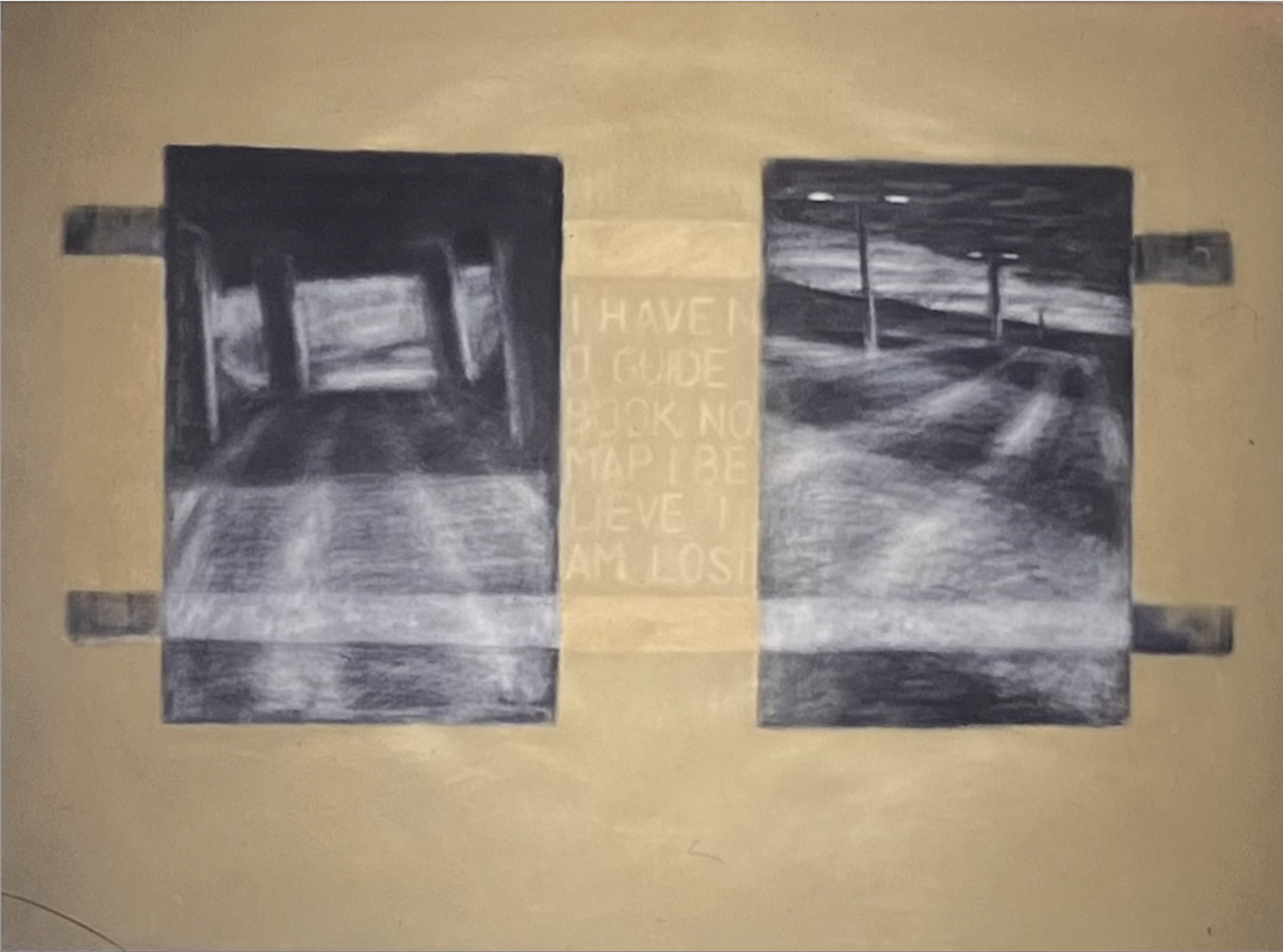
Two Paths, pastel on paper, 29”x41”
Visual images by the author © 2026 Lauren Alwan. All Rights Reserved. No part of the images may be reproduced or transmitted in any form without permission.
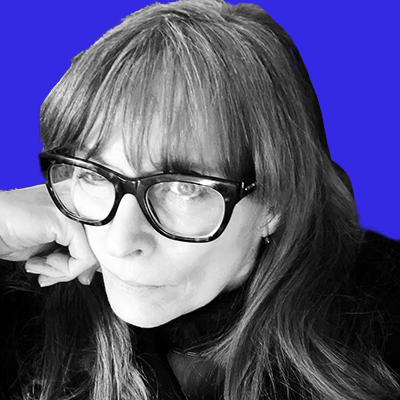
Lauren Alwan's fiction has appeared in the O. Henry Prize Stories, the Southern Review, Alaska Quarterly Review, Bellevue Literary Review, StoryQuarterly, and others. Her essays on literature and personal history have been featured in ZYZZYVA, Alta Journal, The Millions, Catapult, and World Literature Today. The recipient of an O. Henry Prize, she's currently at work on an historical novel of Arab-Turkish cross culture, The Dowry House, which was awarded a First Pages Prize by the de Groot Foundation.
