




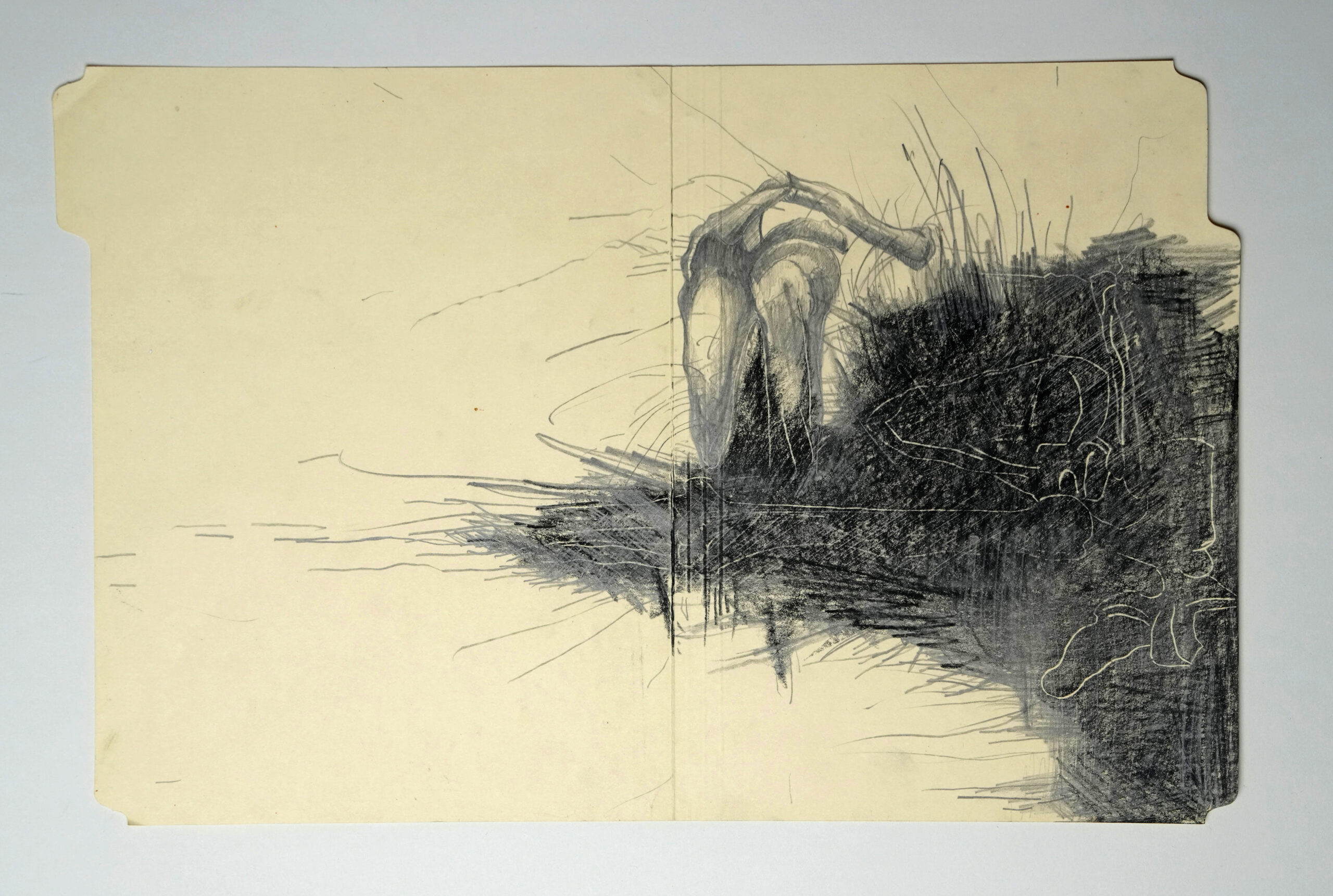
Christine Safatly, Untitled – Lost 4. Pencil, soft pastel, sanguine, 45 x 29.5 cm (2020)
“The end is injury; and all such end
Either by force or fraud works other’s woe.”– Dante
In August 2014, he visited Cairo one last time. We had a work meeting, and then a catch-up drink. He had lost a bit of weight; it was the kind of weight loss that shows on the face. He talked about a recent diagnosis of bipolar disorder, unhappiness with the medication, and a new home by the river in Phnom Penh, which gets him to swim every day. When we were done, he asked to be dropped off at a nearby address. After he stepped out of the car, I peeked at him from my side view mirror as he grew distant. I had a premonition.
The best of us revel in the mystery of absence.
His last disappearance would be for good. I have always been intrigued by his ability to drop off the face of earth, to disconnect from things familiar – his friends and loved ones, his hometown – the stuff through which we shape our sense of self, to define it as we go. One way to romanticize his disappearance is to imagine he was whole on his own; there was a certain artistry in how he disappeared, a certain mastery. When we were young, I signed off my emails with quotes and one of them was “disappearance is joy.” I was infatuated with the idea of dying before dying, with our ability to present a counterweight to that which shackles us in the world – capitalism, overproduction, over-consumption, death of meaning – through a certain act of withdrawal, the stuff of philosophy. It’s an ability that comes from both realizing a certain wholeness to ourselves, and simultaneously, a certain nothingness. But in reality, I am still thinking, trying to write and to make sense while being overly consumed in the world of production and appearance.
He, instead, actually disappeared. As Lebanese poet Talal Haidar wrote, “He opened the dark portals of his imagination / and walked in.”
The word khayal, which is the title of Haidar’s poem, and reappears in the verses, has two meanings in Arabic: “shadow” and “imagination.” I took the liberty to choose the word “imagination” in my translation, perhaps in an attempt to stir the imaginative potential of our intangible trace, our shadow. I am intrigued by the connection between shadow and imagination; Ibn Arabi, for instance, speaks about how in the shadow, we connect to a lightened vision and disconnect from an existentialist vision. Imagination begins here.
In his previous disappearances, I took it upon myself to go find him. As we went through liberal education training in university together, I was becoming a journalist and he, a financial analyst and businessman. In theory, these could be opposite worlds, but we were drawn to each other. We read poetry and fiction, organized with Palestine activism groups in the heydays of the second Intifada, and wrestled with the post-9/11 world, marked particularly for us by the US war on Iraq, but also the broader surfacing of identity politics: them and us and whatnot, until it became stifling and we started looking elsewhere. These were our common terrains. Then, he would abandon these terrains to his secret hideouts, and I was to go find him. Besides the anger of losing him to his unknown worlds, I was also curious and jealous he had them. I wanted to see and to scavenge. It also felt like a search for truth, or at least an exercise for it. Looking back, it was an early practice of journalism.
In earlier times when I managed to find him, I learned that he was growing successful in his career. He was elevated to the black box of top decision makers in one of the most important multinational freight companies. He was struggling. The wholeness I imagined in him in his distance was rather a self made of irreconcilable fragments that he often found difficult to expose to close and loved ones. He was infatuated by the self-producibility of capitalism and couldn’t cope with the structural injustices that allow it to be. He was homesick for his neighborhood in south Cairo, but liked the razor-edge feel of his new Scandinavian home. There, he thought, loving men was more possible. Or differently put, being who he is, while loving men, felt easier. He also liked to sign off his emails with quotes; one of them was by Joseph Conrad: “…he wants to be so, and again he wants to be so … he wants to be a saint, and he wants to be a devil-and every time he shuts his eyes he sees himself a very fine fellow-so fine as he can never be…”
In one of the first encounters after he had gone incommunicado for over a year, there was identification, a mirroring of sorts that I wanted to resist, perhaps in order to stay sane, or from the conviction that the truth would be distorted by the bias of my own fragments. Oftentimes, we tend to understand pain in subjective ways. Perhaps there is no such thing as a full-on act of empathy where the self is erased. There is no truth there. We must be mature enough to avoid shifting to a full-on projection of our own pain, especially because stories of pain are best told when fictionalized with a bit of projection. I wonder what this exercise of intersubjectivity entails, this rendering of storytelling into a political act as Hannah Arendt puts it. I trust there is a certain truth in this dialectic encounter, but something remains unanswered about the truth of his pain. And mine.
In the last ten years, I learned about the concept of a fever of unknown origins, and liked to assign it to myself as a diagnosis to fevers that would come to me, short of announcing any underlying condition. I would have some suspicions of it being a somatic response to situations that I am unable to handle emotionally; there is some solace in the undetermined nature of this suspicion, this guess work. I also liked the submission of science, its unknowing. And while I know my friend had, at different points in time, a well-constructed and narrated story of his pain, one that I could easily also appropriate and re-narrate through my own pain, I know there was something else, more profound, more buried and more sedimented in the shadows of our unconsciousness. Like the fever of unknown origin, there is pain of unknown origin.
I do not want to seek too much comfort in the idea of the unknown, as it is not too dissociated from an increasing connection I have with the notion of effortlessness, as well as a sense of failure in journalism as a life-long, truth-finding endeavor. Put differently, I don’t want to surrender my lethargy easily towards the philosophy of the unknown. Rather, I settle with the fact that what we know from both universal experience and our own particular experience is only partial to some truth.
Sometimes I toy with the idea that this pain of unknown origin lies somewhere in the underside of public domain, where the deeper layers of our consciousnesses lose the gates demarcating them, and exist as an open field in a space that precedes ego. It is like when I watch some of my own plants grow out of cuttings I gave to friends; I imagine our little gardens extending into each other in one big green field. When the philosophers of psychology claim that the depths of our psychic substance is made of sedimented histories, I imagine these sedimented histories as one extended field transcending our egos, debris belonging to no one. And, yet, to everyone.
Still, I poke into the skin of my wounds, particularly my thumb (it is the most accessible). Oftentimes, it happens like an addiction that bypasses reason; for why would one inflict so much pain onto oneself? Why would one poke a wound until it bleeds and hurts so much that one can no longer poke it from the pain?
An old love had made me a music compilation that included Johnny Cash’s version of “Hurt.” I liked it whimsically without fragmenting it into music and lyrics and meaning. Years after the love was gone, and the wound-poking continued, it resonated. “I hurt myself today / to see if I still feel.” There is an act of investigation, of inquiry, in poking the wound, in unearthing layers of pain. There is also somewhere a belief that an intensification of pain could take us to a threshold we long for.
This summer, I started reading Dante’s The Inferno, in an attempt to seek an understanding, or a semblance of it, through the void the imagination operates in. What does it look like to be rescued from the dark world? What does the journey look like? What earthly justices are possible, even in the muted shape of imaging? And when it gets tiring to read poetry from the 14th century, I close the book and start poking my wounds. When the pain is unbearable and the bleeding satisfactory, I start speaking to you, still wondering, what was your pain trying to register? What could your suspended speech be saying? Where do I go to find a rupture in your absence? To hear your wisdom? How can we be present in this world through an ongoing encounter between what we know and what we don’t know?
I know I hear you at times, but not all the time, and I know that in this hearing, I am who I am. But when I don’t hear you, I turn up the volume to an Irish pop band, uttering the words raise your glasses then, to absent friends.
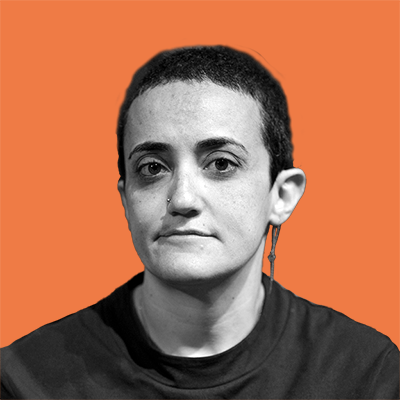
Lina Atallah is a journalist based in Cairo and the founding editor of Mada Masr.
لينا عطالله صحفية وناشرة موقع مدى مصر.
- Lina Atallah | لينا عطاللهhttps://rustedradishes.com/author/lina-atallah-%d9%84%d9%8a%d9%86%d8%a7-%d8%b9%d8%b7%d8%a7%d9%84%d9%84%d9%87/