







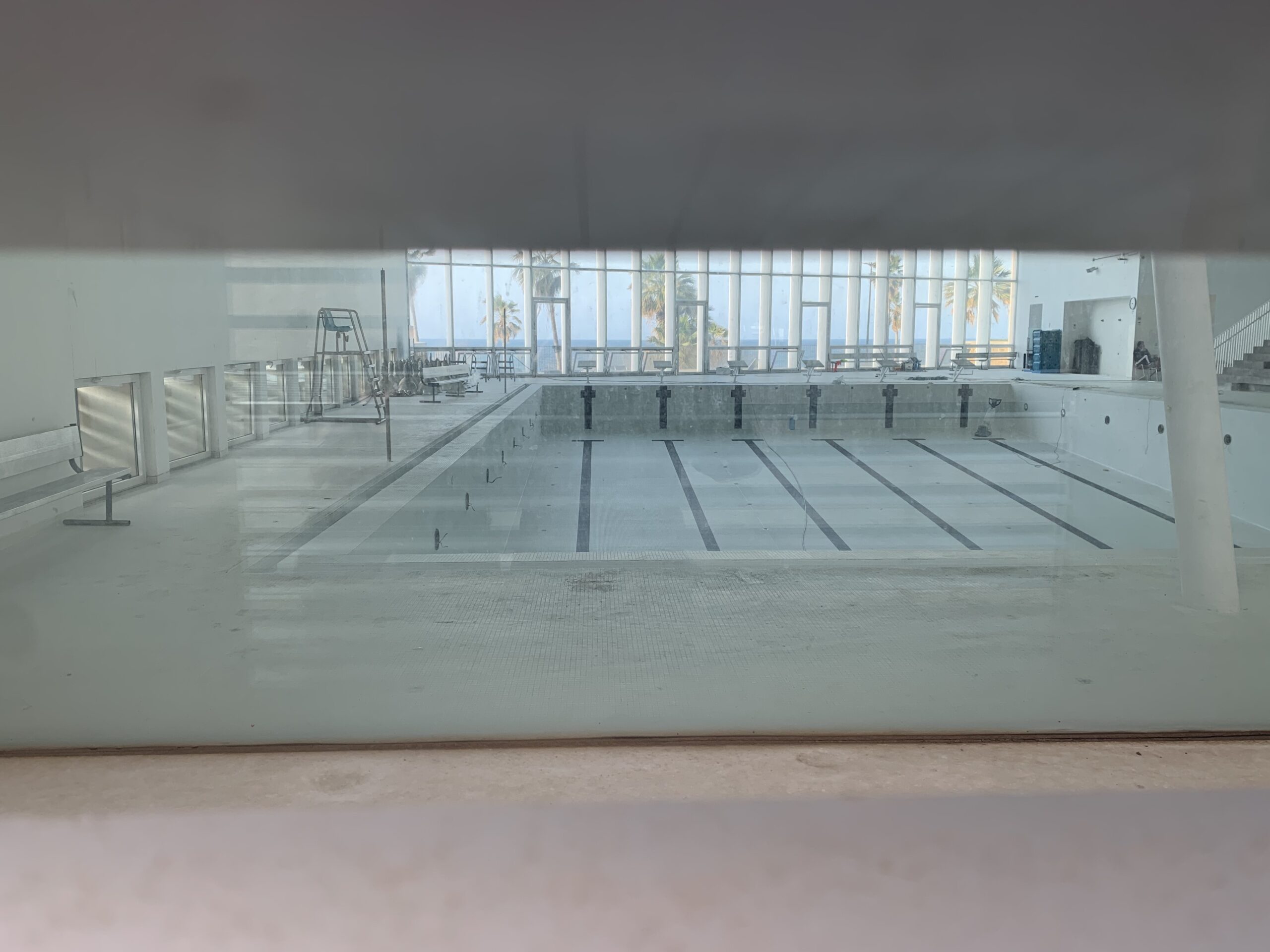
Hala Auji, Pool (2021)
“Yes, I’m—we’re—fine… unhurt. Thanks for aski–”
“…now that you mention it, I do feel different. It’s like there’s this pressure, or it feels like pressure, is that what it’s called? You know that feeling when you—well, it’s like in the pool—I mean when your head is in the pool—and the water rushes in your ears, and you’re—maybe—supposed to find it relaxing? But it isn’t at all. It makes you feel like you’re truly Alone—not alone, alone, obviously there are usually other people in the pool—but it sounds like black—not the color—but the feeli—”
“I guess I’m not explaining it well…do you like art?”
“What I mean is—and I have a point here—it’s like this guy’s sculptures…Funny enough, it’s quite a cliché to mention him. But, I guess, if you don’t know much about art, then it’s fine. It’s not like you’re a student in my class—I mean, you won’t think it’s so obvious. So, I guess I can mention hi—”
“Yes, I have a point. His name is Anish Kapoor, he has this trademark for the blackest black—Vanta…something—I feel like that—I mean—my ears feel like that…”
“You can Google it. Maybe type in Kapoor and black…it’s really well known, you sh—”
“Ok…well, no. I’m hearing the same—well, unhearing—or hearing how I normally hear when I can’t hear, is that what yo—”
“Um…yeah. They feel ok. Well, you know how I feel about them. I think I told you when I was in the clinic the last time, when I panicked and got that year’s supply of new batteries, remember? The dollar was at, like, three thou or so. Wow…it was before the corona stuff. Huh…”
“Yes—sorry—I’m still here. Right. As I was saying, about them, I know they’re there so I can’t unfeel them, if yo—”
“Oh, you didn’t mean that literally…”
“I guess you can say—I think—they’re a little off.”
“I mean, they work, but I can’t tell if they’re working…things feel further away than they should…it’s like there’s dust in between them and the path to my brain—not the grey-pink dust we saw a week ago, of course, that would be weird…”
“Right. Back to my point. I feel them more, but I hear with them less, does that make sense?”
“Sorry—it’s totally me—I don’t explain things like this very well. Which is ironic, since I have to do tons of explaining in my job. But it’s like the words get blown to dust on my tongue—just bits and pieces where ideas once were—when I try to describe the hearing I feel, but not the hearing I hear, or is it the hearing I unhear? It’s lik—”
“Oh…yes—yes, of course—there are others to check—I’m sorry. I took up all your time.”
“No, no…I wasn’t that close to it…did I say that? I never meant to imply it. I’m fine. They—we—are fine. I mean, they work fine. They’re fine—perfect, even—I don’t need new ones…”
“Sure, sorry agai—”

Hala Auji is a writer and art historian. She is associate professor and the Hamad bin Khalifa Endowed Chair for Islamic Art in the Department of Art History at Virginia Commonwealth University, Richmond. Her work focuses on the visual dimensions of modernity in the eastern Mediterranean, including print culture, book history, museum practices, and portraiture. She’s the author of Printing Arab Modernity: Book Culture and the American Press in Nineteenth-Century Beirut(Brill, 2016).
- Hala Aujihttps://rustedradishes.com/author/hala-auji/

