







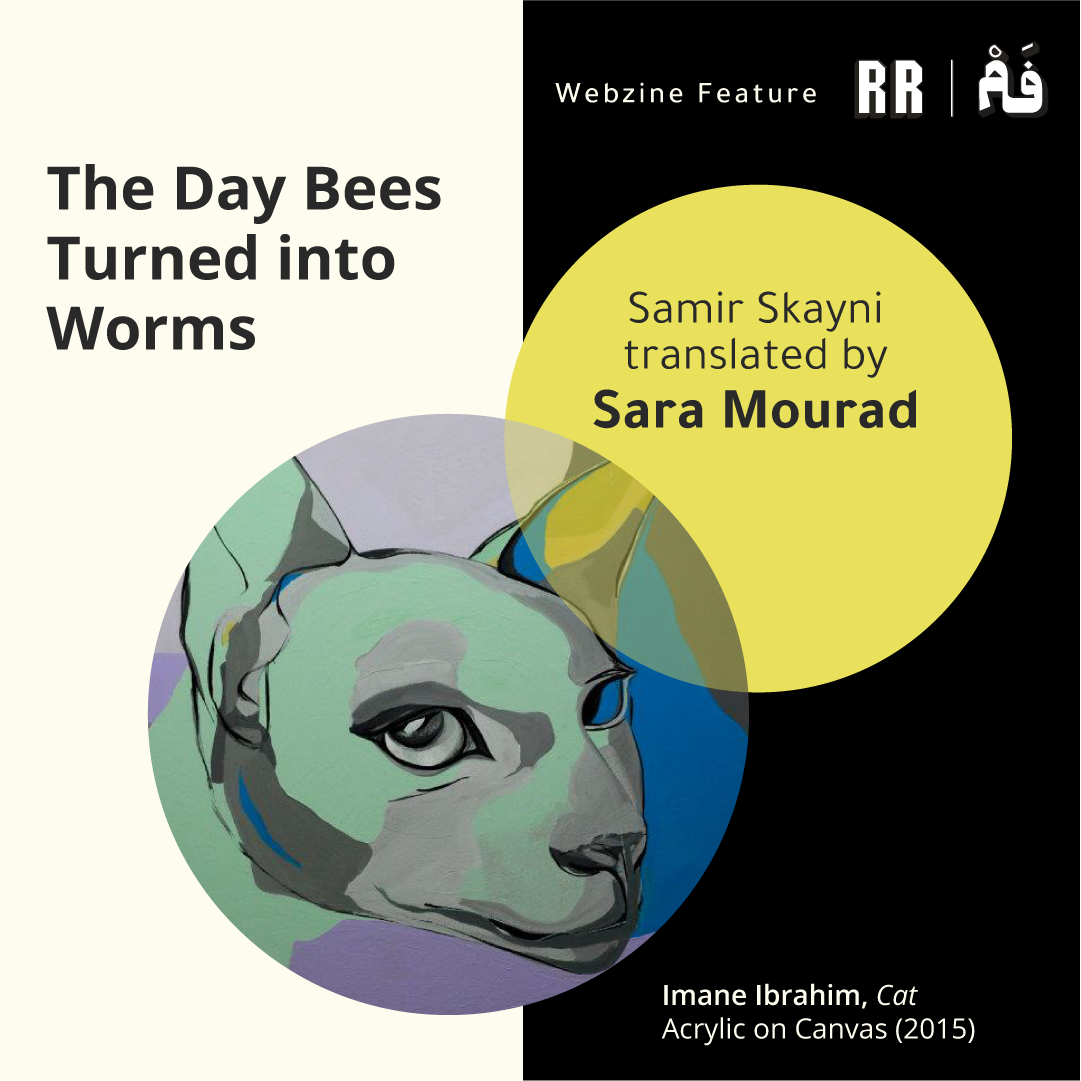

Imane Ibrahim, Cat, Acrylic on Canvas (2015).
Whenever I’d spot a pregnant cat on the street, I’d feel an overpowering urge to kick it.
To kick the pregnant cat, right there on her round belly. Like that, one strike. For no reason. And without hesitation.
I wasn’t always like this. I mean, I love cats. I still love them. But, I don’t know. Just like that, I grew sick of the sight of pregnant cats. Weeks went by, and the cats were pregnant still. February ended without a single birth. I asked a friend, and he said it is strange indeed. He too had no answers.
He had also grown sick of the sight of pregnant cats: “Weeks have gone by and the cats are pregnant still. February has come and gone without a single birth. I asked a friend, and he said yes, it is strange indeed. I don’t have an answer. All, or most of them, were supposed to give birth at the beginning of ….” And he went silent.
“Of…?” I asked
“You know,” he said. “The beginning of…” He went silent again.
“Say it, the beginning of…?”
Many weeks later – 6, 8, 10…we grew bored of counting, 12, maybe – we woke up to find that all the neighborhood cats had delivered their little kittens, in one go. A resounding meow. As early as their first days, the kittens had clear vision and a coat of fluff. Stranger still: Their teeth (or fangs, to be more precise) were prominent. They had been devouring flesh since they were born, so much so that some were capable of grinding bones.
For some unknown reason, bones were abundant in this land.
❂
The kittens caused a stir. Not just because of their delayed births, but also because of how impatient the neighborhood residents had grown with them, which required a townhall meeting with the municipality to explore the most merciful way to get rid of the cats. They would say “merciful” while exchanging winks. What mattered was to dispose of them. And the reason? Fluff.
I’ll give you some context: Back then, we spent many days in thick wool clothes. More than usual. Perhaps we wore wool for over half of the year. Then we switched to t-shirts. Shame alone prevented us from walking the streets naked. The year was marked by a strange split: either freezing cold or sweltering heat. You either wore wool (which was a magnet for cat fluff) or you walked barely dressed (with fluff sticking to the sweat oozing from your pores).
Perched between car tires, the kittens-with-prominent-fangs watched as the barely visible fluff took control of people’s fate and their moods. They had cocky smiles, ignorant as they were of what was being concocted for them.
The strange seasonal split affected market sales: As the demand for “moderate” clothing dwindled, some shops closed while others invested exclusively in heavy coats and fine skirts. All the rest was stocked in piles in warehouses, not one buyer in sight, until it was decided that they must be discarded to prevent the spread of mites and fleas and skin rashes.
It was common to walk in the villages and see heaps of clothes burning. People would throw them into the rising flames and say that no one will wear these clothes from here on out, after the end of ….
“Of…?” I asked
And they said: “You know, of…”
❂
It was also common to walk in the villages and see grapes on fire. They weren’t grapes, really, but something like them. The crop did not ripen that year, but remained sour. At first my father thought that his grapevine had contracted a disease. This is the grapevine that my grandfather had planted, building its metallic grid with his own hands. (It dried out for one year only, the year he passed. And I believed that it wouldn’t survive him. But it flowered again, feeding, when it ripened, the entire village).
That year, the crop remained sour. Sour grapes for a week, then two. 6, 8,10 long weeks … we grew bored of counting. 12, maybe. We woke up one day to find it ripe, almost past its prime. The vine was filled with wasps chomping, chomping, chomping, juice dripping as they ravaged the grapes. Drip, drip, drip until the ground overflowed with a viscous liquid that swallowed your shoe, which made a squeaking sound that forced you to notice its presence.
The wasps, we shooed them away with brooms. Then my father started a fire to repel them with smoke. A wasp stung me. Then two. So many wasps, 6, 8, 10…I grew bored of counting. 12, maybe. My eyes burned and swelled until I saw everything in red. I almost gouged them out. I told myself I’d replace them with grapes. I was about to but my father’s screams cut me off: Another wasp bit his neck, in quick succession, and if it were not for sheer luck, the wasp would’ve pierced his vein.
We later found out that the same scene was repeated in the rest of the homes. That day was engraved in the memory of the villages, across the South and to the Beqaa. The villagers had one day to harvest the grapes, and were divided as such:
1.Those who rushed to the stalls to sell them;
2.Those who reserved a spot at the presses to make molasses;
3.Those who spared themselves the pain of the crowd, by laying their grapes out on the rooftop to make raisins.
Legend has it that for one day only, few enjoyed fresh, edible grapes. Upon inquiry, they confessed that they struck a deal with the wasps: They threw bones to lure the kittens-with-prominent-fangs, trapping them in sticky goo. In return, the wasps agreed to spare the grapes, preying instead on the helplessly trapped kittens-with-prominent-fangs as the landowners looked the other way.
What concerns us here is that most of the villagers did not eat fresh grapes, except for that one day. In their gatherings, they called it “the day after the sour grapes and before the molasses.” Approximately before molasses. Back then it was common to walk in the villages and see grapes ablaze, on top of the clothes. I caught sight of a man walking with his son towards the grape-burning crowds: He pulled his phone out of his pocket, held a vine in front of it, and snapped a photo.
One snapshot, then two. Many shots, 6, 8, 10…I grew bored of counting. 12, maybe. Then he took a photo of his son next to the vine, and threw them into the bonfire.
❂
The children. Do you remember Lina? That child and his father reminded me of Lina and her father. I wrote her story when I saw her two years ago in the neighborhood: She was crying, and her father was trying to console her. The owner of the pastry shop said, “I’m sorry, sir. We are out today. The cream spoiled because of the electricity cuts.”
The father said, “They don’t have any, Lina. Pick something else.”
But Lina sobbed, repeating: “No baba, I want uthmaliyyeh.” And again, with snot dripping from her nose: “I want uthmaliyyeh!”
The following year the electricity issue was resolved (almost). Cream pastries gradually returned to the shops, so the father took his daughter to have the sweets she craved, as she saw them in the photo: a golden disk / a creamy layer / another disk dripping with sugar syrup / topped with red garnish. But who would’ve predicted that Lina would be screwed once again?
Orange blossom was out of stock. All Arabic sweets were now sold without garnish. The tasty delicacies in the photos remained out of reach. Instead, there was only a bland golden disk topped with a dollop of cream. That beautiful crimson red, gone. Not a single orange blossomed that year.
In the South, the Abu el Aswad road looked dreadful; the groves that once stretched out on both its sides now appeared as walls, closing in. I used to drive there just to catch a whiff of the blossoms, and now the road stunk of rot and humidity. How did we end up with so much rot? I mumbled to myself. Then I remembered: This grove was meant to bloom in the…
I went silent.
In…? I asked myself.
This goddamned word that I could no longer find: The orange was meant to bloom in the…
Abu el Aswad’s orange grove looked dreadful. Odorless, tasteless, colorless. Wood and dead matter, and meows blasting from over there, and the sound of fangs grinding, and yellow leaves. An anger so white. I dream in blue. My mood is gray. And I see red; I could name all the colors around me except for one.
It had disappeared.
❂
Then I remembered.
My friend who loves green. I haven’t seen her for weeks. 6, 8,10…I haven’t grown bored of counting. 12? I mean, she disappeared. And I waited. Autumn went by, then winter, even…ended.
My friend who loves green, whom I haven’t seen for weeks.
I caught her one day eating a bee. When she realized I was watching, she spit it out, saying the bee had flown into her mouth. But I knew that she ate bees. She would choose the ones that had drunk the most wisteria juice and keep them alive in her mouth for a moment, let them play a little before swallowing.[1]From Rodoreda, Mercè. Death in Spring. Translated by Martha Tennent. Rochester, NY: Open Letter, 2009. Made available to the author through the Arabic translation by Hilal Chouman: موت في … Continue reading
For a moment, I felt I was a bee, infinitely small and fragile. I felt I was drowning in her throat, melting. I tried so hard to swallow my stinger, despite the death instinct instructing me otherwise if I wanted to save myself, if I wanted to be spat out again, if I wanted to survive. I was delirious. I was an infinitely small and fragile bee drowning in endless intestines.
Then I remembered.
Neither the plants bloomed this year, nor did the blossoms produce nectar. The bees started to shrink, and were almost emaciated. They were starving. The Ministry of Health declared that hunger devoured 36 bees.
And I saw her:
The queen bee, exhausted by decay and lethargy, as she gathered and consulted her parish. The buzzing was loud – zzzzzzzz.
Just like that, one continuous buzz – zzzzzzz,
The debate got heated – zzzzzzzzz,
After a while, the hive nodded their heads – zzzzzzz,
suggesting their approval of the decision that was just reached – zzzzzzz,
even if reluctantly – z.
And I, ignorant in the language of bees, couldn’t follow. But what concerns us here, after negotiations came to a close, is that the bees started to swarm around hay, manure, and cow’s asses. At first, many bees were killed by the sudden flicks of cattle tails. The kittens-with-prominent-fangs would scramble to lick them as they fell to the ground. They would push and shove one another, their meows growing louder in the stampede, mingling into a unified and continuous howl as if they were about to explode all at once.
With time, the bees learned how to preempt the fatal blows, swiftly flying off like mosquitos. They managed to live and survive on cattle, then on their fodder. And here we are: The bees found a new source of nourishment, but the honey spoiled. It became infested with wormlike creatures. People said these were the new eggs. White cocoons. White cocoons. White cocoons. White cocoons. White cocoons …. Until bees turned into worms.
I was mumbling to myself: “Dear lord, summer is cold and nights are sunny, let there be worms where once there was honey.”
❂
The new scent of bees was repulsive. They smelled of streets…I try to describe it, but to smell it is a different matter. People kept to themselves and hid in their homes. They moved away from the windows, they even stopped trying to peek outside. Sensitive content, they were told.
We lost grip of what was happening outside. The streets were growing narrower. Only a few remained. What disappeared was forgotten. And with each day, so much disappeared. Only the kittens-with-prominent-fangs were multiplying (only now do I realize: I should’ve kicked them at the beginning of the text). Places are monochromatic, time is suspended. And …? I don’t know. The wasps have grown monstrous. The grapes are still burning. And I am here, in my makeshift bunker. 60 kilograms of sensitive content.
Delirious. I am delirious and holding myself together, tripping on a feeling of whatchamacallit. Haunted by so many questions. 6, 8,10… I’ve grown bored of counting. 12, maybe. I am awakened by a gentle sound. Faintly through the feral howls, I could hear it. The sound of familiar steps. Light steps moving further away, into the wild side. I went outside to follow their trail, looking for answers.
And I saw: Bones were abundant in this land.
The wasps were still after me. A shadow moved before me. Then it disappeared. It was always one step ahead of me, at least, and still I chased it. As I got closer, I finally understood what it was doing all along.
I noticed the rubble of the city, what remained of its walls, the ruins, across which the shadow had repeatedly inscribed a single line:
“They managed to cut all the flowers. Don’t let them keep…from coming.”
This text was first published in Arabic in Rusted Radishes’ print issue Pain (2025), and later on its webzine.

Sara Mourad is a writer and scholar from Beirut. Spanning media, literature, and visual culture, her work engages questions of identity, memory, and place at the intersection of intimate and public life. Moving between writing and curatorial practice, she explores gender and sexual politics as they take form in cultural production. Sara is an assistant professor of media studies at the American University of Beirut. She is currently at work on her first monograph, The Skull in the Attic: An Intimate History of Home in Postwar Lebanon.
سارة مراد كاتبة وأكاديمية، مختصّة بالفكر والنقد النسوي. تستكشف كتاباتها تقاطعات الهويّة والذاكرة والمكان في التاريخ الشخصي والعام، كما سياسات الجنس والجندر. صدرت لها نصوص ومقالات في مجلات أكاديمية وأدبية ومنصات إعلامية. تعمل حالياً على مفهوم الأمومة في سير النساء. تشغل مراد منصب أستاذة مساعدة في برنامج دراسات الإعلام في الجامعة الأميركية في بيروت، حيث تدمج بين الممارسة الأكاديمية وتنظيم الفعاليات الثقافية في مقاربتها لقضايا الإعلام والجندر.

سمير سكيني، كاتب وصحفي في بيروت، له يد في الفنون ويد في السياسة. تنقّل بين اختصاصَي الهندسة المعمارية والفلسفة في الجامعة اللبنانية، قبل أن يرسوَ في عالم الصحافة. نشر عدّة مقالات ومساهمات حول مواضيع اجتماعية- نفس اجتماعية- سياسية- ومتابعات للنشاط الطلّابي في لبنان، وذلك في عدّة مجلّات ومواقع. صدر له كتاب «الأقحوان ينبت في الشيّاح» (2018) وكتاب «نهار أحد» (2020)، عن دار الفارابي.
Samir Skayni is a journalist based in Beirut, with his writing partner: Simba (a long-haired creature). He moved between the disciplines of architecture and philosophy at the Lebanese University before finally settling in the field of writing. He has published two novels with Dar al-Farabi: The Chrysanthemum Grows in Shiyah (2018) and Once Upon a Sunday (2020). He is currently working on a third project exploring the concept of “the atrocious” in the region.
-
Samir Skayni | سمير سكينيhttps://rustedradishes.com/author/samir-skayni-%d8%b3%d9%85%d9%8a%d8%b1-%d8%b3%d9%83%d9%8a%d9%86%d9%8a/

-
Samir Skayni | سمير سكينيhttps://rustedradishes.com/author/samir-skayni-%d8%b3%d9%85%d9%8a%d8%b1-%d8%b3%d9%83%d9%8a%d9%86%d9%8a/

Footnotes:
| ↑1 | From Rodoreda, Mercè. Death in Spring. Translated by Martha Tennent. Rochester, NY: Open Letter, 2009. Made available to the author through the Arabic translation by Hilal Chouman: موت في الربيع. |
|---|
