




Seven minutes out of the house, and I’m a fish flung onto land with a hook in its mouth, twisting on the tip of someone’s awful dream. I try to talk sense to myself, I do. Raw from want of use, my throat scratches. I haven’t spoken to anyone in days, and most of me would rather keep it that way. I’m waiting for her by the mosque she sent the location for, smoking a joyless joint in the car, a piss warm beer between my thighs. Before I give up, I text her. The moon is sickly and low in a violet brush evening sky.
This dead-end street is a few minutes’ drive from my flat. It’s like a deserted film-set. The metro is on the other side of the road. A low wall runs all along it with martyred traces of graffiti, bright flowers painted over in a brutish government gray, mutilated like their audience. And there’s a new unsigned artwork I haven’t seen before, stenciled in the shape of a sandwich, and it reads:
We’re tired of sandwiches
A muted howl. A few selves, a few horrors ago, that piece of unlikely radical art would have stirred some sense of hope in me. Not anymore. The street lights are out, but one of them is flickering, a silent black-and-white disco.
I’m waiting for Sarah. I don’t know who she is. Our common friend, Karim, the one whose birthday party we’re headed to, asked me if I’d pick her up on my way, and I think he was hinting I should go ahead and try my luck. But who is in the mood for love these days? She sends a heart emoji, writes something, deletes it. Just come down already. I think a little ketamine is in order, our psychic bandaid. I take the baggie out of my wallet, stick my car key in it, glance around me. Not a human soul around. I block my left nostril with a finger and scoop a bump the shape of a teardrop into the right one, close my eyes to let the sting through. I pick up my phone and look for a track to play before the swirl kicks in, maybe go ambient and dream pop spacey to soothe the jittery background angst. But there’s someone, suddenly out of the shadows, smack against the window. I almost drop the baggie. I don’t want to deal with whatever this is, not now, not later, just let me sit my days out in hazy oblivion please, in some great unbroken solitude, numb to the crude theatre of reality.
The man looks like a civil servant, or one of those old school lawyers or accountants expiring of stress and nicotine and malnutrition on untidy desks, ruined at birth, barely inhabiting a threadbare brown suit, tie loose and thick around his neck like a noose, dangling from his emaciated face beaded with sweat, something vacant in his fast blinking eyes, pleading quietly but insistently, holding out his hand, taking it to his chest, chaotic and complex body-language I can’t quite grasp in the blurry state I’m in, and then seemingly telling me to roll down the window.
I don’t want to do that. What am I protecting here? What is this boundary? That man, out there, this tangled maze, this me I don’t trust or understand or respect, really, any longer, in here. I shake my head and mumble: I’m sorry, I’m so sorry. It’s too much, can’t do this anymore, the misery on the streets of this afflicted city is becoming unfathomable. Countless hands stretched out, trembling in despair.
I try not to look at him, but can feel his anguish through the glass. He’s not going anywhere, pushing me to the limits of my discomfort. A mild hatred leaks out in me against my will. Please go away. He knows I’ll break soon, going for the pain-point, and mine used to be an open jugular. He can feel the tension, the crumbling barricade I’m trying to wedge between us, the sorrow of it all. The shame. The guilt like a splattered spleen. Why did it get so bleak, to have been born? What have we done to fate to lash out at us like this? Barebacking life. I think he’s crying, and I’m spacing out in cotton candy waves. My god, the gore.
Frozen by his tears glistening in the corner of my eye, by the reaction I’ve found myself trapped in, feathered by the oceanic sweep of the free floating anesthetic swimming through me, I can’t reach for my wallet. Too late for that somehow, too obscene. Spare change won’t fix his condition. What if he is faking the sobs? Scamming? How did I get so cruel? Why is this man there and I here or something else altogether, or, even better, why not nothing at all? Why am I thinking of the father who walked out on me and my mother to elope with a flight attendant when I was on all fours (I don’t really know when exactly because no one ever talked about it)? Where the hell is that Sarah? I’m ready to leave without her, maybe retreat back home, cut my losses. A knock on the other window. I jump in my seat. That lonesome bump of ketamine was ill-timed and ill-omened. It must be her. To my left the man is no longer crying, but lost in thought. The blue train rumbles by. It shakes the earth. I reluctantly unlock the doors. She gets in, I lock back up. I feel naked. Sarah seems flustered, at home in the predicament she’s stumbled into. She smells of cheap liquor and good coffee.
“Hey, yeah, hi, I…I actually have no idea what to do with this man,” I mumble helplessly, words crashing into each other in my mouth.
“What man?” she asks.
Something in her bag is distracting her. She looks past me. Her neck is so thin. It shivers in my vision.
“What does he want, he doesn’t look like a beggar,” she says.
“I’m really high and confused, should I just give him money? He’s been standing there for a while.” My voice trails off.
“Roll down the window. Let’s talk to him, maybe he needs help.”
Ketamine is not sure about that.
“He was like crying right before you came,” I side-whisper in English.
“His aura is off.”
“What?”
“He’s heavy, his time’s all used up,” she says, looking ahead of her.
I don’t know why but I shudder.
Why did I leave my little flat and my books and music and plants and the ghost of my dog?
“Should we just go?” I ask.
“I don’t know, why are you asking me?”
I half-turn to the guy and wave goodbye awkwardly.
“Give him this,” she says and hands me a twenty pound bill from her bag.
“I have money in my backpack, but it’s degrading for him,” I mutter.
“I’ll do it,” she says and gets out of the car, walks around the back, and holds out the money, does this thing where she touches the bicep of her extended arm with her other hand, a ritual of sorts. The man turns to her slowly, arms hanging loosely by his sides. Two bats swerve under the stuttering street lamp. She continues holding out her hand in the same gesture. No response from the man. I roll down the window. His breath is rattling in his throat.
“Please come with me,” he says, his eyes darting all over.
Luckily, that Sarah is sensible. “I’m really sorry but we’re late, we have to go, are you sure you don’t need this?” she says.
“You must come with me,” the man says.
She clips back into the car.
I drive away slowly, the man, staring at us, fading out in the rearview mirror. For a minute or so we keep quiet. We wordlessly agree we’re not going to talk about what happened. What if we could have saved him from something for a little while? Do I turn? Don’t look back. It’s endless.
“What’s your star sign?” she asks.
“Can you guess?”
She leans back in her seat and looks me up and down. Her face is bony, but pretty, an ancient oasis beauty, those caramel eyes and the dark halos under them. She’s vaguely familiar.
“Pisces?” she says.
“There’s a Pisces in there somewhere, ascending or descending or something, but no, I’m a Capricorn.”
“Oh, okay, how you holding up?” she says and chuckles.
“What do you think?”
“I know, I’m sorry,” she says and sighs. “Imagine a Capricorn man who is also half-German though.”
I don’t get the association, but I do get the point. “That would be a handful,” I reply.
“Exactly. But you, you must be kinky in bed,” she says, matter of factly, nothing flirty in it.
There’s a wedding procession around us on the corniche, overflowing cars swerving and zigzagging and honking away, the glinty outfits and the little boys and girls in tiny suits and dresses on their mothers’ laps, a symphony of blaring stereos and ululations and clapping. Two young men are dancing out of a window like eels. One of them lights a red flare, and it’s as though we’re floating in the belly of a Jinn.
“How do two people find and fall in love with each other and keep it anymore?” Sarah says as we both marvel at the foison of sound and light we’re drifting through. She reaches over and honks a tune in celebration.
And I remember where I saw her, it comes to me. I was at a friend’s house, by the billiards table. She, too, is some sort of artist. She smoked a medley of herbs instead of tobacco, sage and chamomile and lavender. And when she got drunk, she kept asking for cocaine. It was a Sunday night. She’d interrupt the conversation and ask if anyone has any coke, Can we get some please coz I can’t order in a gram on my own? And every time no one would say anything; it was already two in the morning, and not that kind of evening.
“We’ve met before, by the way,” I say.
She sharpens her eyes at me.
“Oh my god, it’s you…you look different,” she says.
“The hair and the beard, yeah.”
“Now hold on, how the fuck are you friends with Karim? I mean you’re too different, his politics are nasty and regressive—a toxic chauvinist narcissist bougie sleazy libertarian asshole, honestly. He’s not even boycotting, and he’s like 40. Is there any hope left for him, to change, you think?”
“How old are you?” I ask, can’t really tell, mid or late 30’s like me maybe.
“I’m 29. I look old.”
“Not really,” I lie. “I don’t know Karim that well,” I go on, “we met two years ago at a house party where he was DJing. Then I did the visuals for his trip-hop EP after that. I see what you’re saying, but I like his taste in music, and he’s been kind and thoughtful with me.”
I take a sip of beer.
“Can I have some?” she asks.
I pass the bottle. She downs a third of it in one go, and that annoys me. There is much worse than being alone, I guess.
“You know,” she says, “Karim yelled at me really badly one night when it was just the two of us at his place, and I mean like disturbingly verbal rape badly. I have no idea why I fucked that dude to be totally honest.”
“What did you do?” I ask.
“Why he went ape shit on me, you mean?”
Such a desolate thing to say, it tugs at my heart. You can almost touch the hurt beneath.
“No, no, I mean when he yelled at you, what did you do?”
“I didn’t throw anything at him this time, if that’s what you’re asking.”
I ask her for a drag from her cigarette. It’s even worse than I expected.
“You know,” she says, “at one point, I managed to convince myself that people are good, just with some ugliness in there, from the trains of trauma they have been flattened under, but now I know that everyone’s sick and rotten at root, that’s the base. Look at the cruelty of children. For some reason God made us this way, but He knows better than we ever will.”
No irony there, from the duny lips of an unlikely true-believer. I want to ask her what happened to make her this way, but I can’t. The wedding caravan is far behind us now. It’s Tuesday night, late. I can barely see the Nile past all the vomit-of-garish new-loud-and-soulless-gold-everything army restaurants and cafes shoved down our throats.
“How does that make you feel?” I ask instead.
Her lips are pressed tightly together. “It makes me feel like a cracked, damaged thing.”
“Would you like a bump of K?” I ask.
“Ahh, finally, please,” she says and holds out an open palm, give me, give me.
I love how transparent she is. I pass the wallet.
She fishes out a key from her bag and dips in heavy handedly. I hope she is aware of her limits. I put on some dubby spiked-melancholia music, Burial.
“What is this K, Indian or French or German?” she asks, a tear rolling down her cheek from the sinus burn.
“German? Oh, no thanks! I’m going Global South, Indian all the way,” I joke.
“Did you know I lived there for some time?”
I did not.
“I got married there,” she says and her voice changes as she says it, down a slit.
“Where?”
“Berlin. His mom was German and dad Egyptian.”
Jesus. So that’s where the Capricorn German man comment came from. “And?” I ask.
“It’s a dark city, and not great for addicts.”
“How long did you stay?”
“I don’t know, a year and a half maybe, and then I came back to the mother of hells.”
“No wedding ring.”
“No, no man, that’s over, it died there, in Berlin, like the Jews and Gays and Gypsies. Now it’s just random dick and pussy and bad decisions and ghostings for me.”
“What happened?”
She takes a deep breath from her nose with the lazuli stone ring like a drop of deep sea on her skin. “We just ended up screaming at each other for hours and hours nonstop one day, don’t know why, something about the laundry, I think, and then he punched me, and then we stopped screaming when we both couldn’t go on any longer, and then we had sex, really good sex actually, maybe the best we have ever had, and then it was over…I mean…I wasn’t a cherub or anything, I was verbally abusive back then actually, I hit him a couple of times when I couldn’t stand myself, was too possessive, too scared he’d leave me and never come back coz I have anger and trust and rejection issues, you see, because of my dad, he left us.”
Laceration, the one in the center, the one I know too well. So strange, these synchronicities, these found smudged mirrors.
There’s a microbus in front of us, and I notice the sticker on its back:
We died and this is hell
“My dad left too,” I say.
“Oh, hello, when was the last time you heard from him?”
“I don’t remember exactly, I’ve blocked my childhood out pretty much, maybe when I was 11 or 12 or something. He missed one birthday call, and then he missed them all.”
“Shit, is he still alive?”
“I assume so. Found out I have five brothers and sisters when I was doing my military papers years ago.”
“That must’ve hurt.”
“The evergreen gash.”
“I get it. Freud was right actually. It’s mommy and daddy all the way up and down.”
“Do you hear from yours?” I wait for an answer. She’s chosen a horrible silence for this one. “Men, the universe’s finest work,” I add. “It’s why I’ll never have kids. This poison trail ends with me.”
I need another bump but shouldn’t. I’m driving and it’s already dicey. Bodies are materializing out of nowhere slap in the middle of the road, a cow’s carcass and a sleeping man in a trunk, Sisyphusian street cleaners, police cameras flashing in my face.
“Were you ever married?” she asks.
“I was, once, for seven years, I think, in the US mostly. It died in that sick colony too.”
“What happened?”
“I was out of control and miserable. And when I got better it was too late. Something was missing..
“I get it. And you, drugs?”
“Cocaine, yeah.”
“Same, yeah, cocaine is evil.”
Same cut, same scar.
“Are you okay now?” I ask.
“I’m alright, ups and downs. But mostly I don’t know what to do with the past and what to let go of, and this psychotic world, this country we’re pretending to be living in, man, it’s so fucked up, I mean, really, what is this, is this how it’s going to be, a permanent catastrophe, so many of us leaving, anyone who can, leaves, I for one can’t wait to get out, but go where…people die in the sea just to get away.”
I like Sarah. I don’t think we’ll fall in love though. Somehow, we’ve already established that, and I fall in love fast and easy, by the way. This is a different communion. Maybe we already know what we’ll discover in ourselves in one another, cut from the same shroud.
We somehow make it to our friend’s flat. New unnerving white LED lights are on all over the house, like a hospital. There are too many rich snow-white Egyptians standing around drinking and driveling about nothing. There’s too much cocaine in this place. Thousands of dollars worth of drugs to be hoovered up. Faces I have seen too many times at ungodly afterhours of unadulterated excess and self-loathing. Hours from now, lost in the terrible light of day, they’ll wonder to themselves why they’re still alive. Just beneath the mirth and vacuous talk and glitzy toys, there’s a black hole.
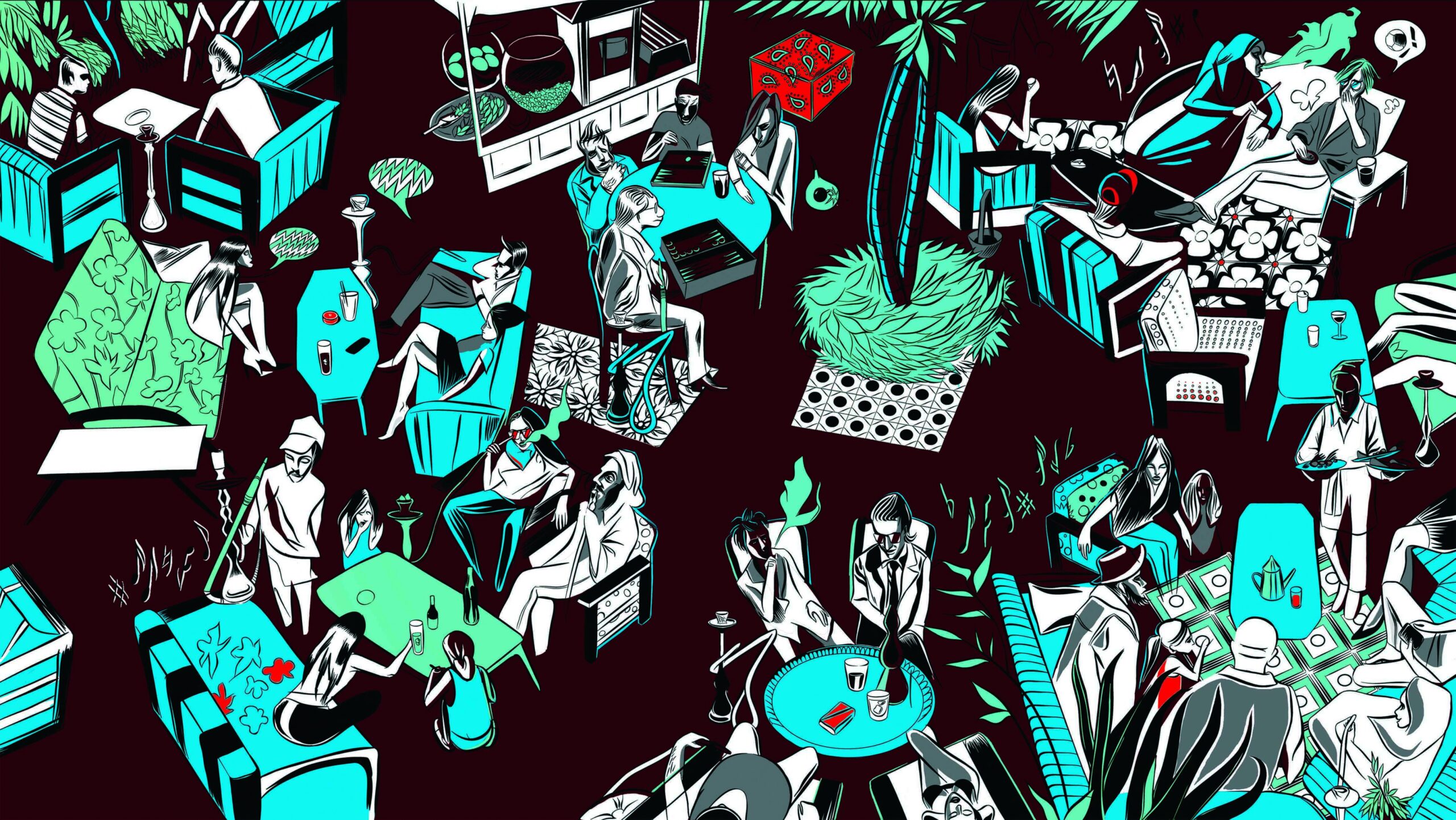
Tracy Chahwan, Urinal Blues, Issue 4: Trans-, (2015)
I do the rounds. It’s painful, same thing over and over again. I find Karim standing in his kitchen, which is where most of the people in the party are stationed, the snorting zone. Booze and blow and bass and bitches, I hear someone say to him. I can’t stand the gray nothingness of cocaine-chatter anymore. I drift into a hallway, find Sarah.
“I can’t take these lights, it’s really bothering me,” I tell her.
“I don’t want to be here either.”
“I don’t mind going back to Maadi now.”
It doesn’t look like she’s ready to call it a night.
“Do you want to go dancing at Jazz Club?” she asks.
I shrug my shoulders.
“Come on, it will be fun,” she says.
No way, I’m about to say, but then I somehow glimpse the transcendent potential in what she’s proposing. A hot flashback reminds me of the bliss I used to milk from that haven, a chance to escape myself, and forget this, all this, for an hour or two. That, when the getting was good on their Alternative Tuesdays, it was a touch of mercy and solace. I check the poster for the event on Instagram. It’s an underground feminist queer collective I know doing a showcase.
“But I don’t have pills,” I say.
“I’m sure I can find a pill there.”
“A half doesn’t do it for me, I need two for myself.”
“You still have K, right?”
“A little bit, yeah,” I say, a bit self-consciously. But she understands the lack I’m trying to plug.
“We’ll figure it out then.”
Old Jazz Club in Agouza, that dimly-lit burrow still holding on for dear life amidst the deluge of destruction unleashed on our poor city, all the trees and places of communal joy and color and memories bulldozed in the name of blood money.
Mario, the manager, short sweet guy, remembers me from all the times I came here religiously to dance and listen to music, alone.
“Good to see you, man, been too long,” he says and lets us in.
“I don’t know why I haven’t been coming here lately, I really don’t know, Mario,” I say. I do know why. Time broke something in me.
The chill bouncer, Mekawi, gives me a handshake and points at my backpack.
“Anything other than books in there?” he asks with a smile.
“Just the books.”
There’s a lot of pink decoration inside, a Pink themed party. Kitsch pink posters. That’s the aesthetic and that’s the energy. It’s feral. It’s warm. No high heels for this crowd. No plastic surgery. No rough edges. It’s slutty, wet. It’s busy already. The dance floor is small but heaving, a rolling tongue of kisses.
I find my favorite nook in the corner next to the DJ booth, luckily unoccupied, a tiny grotto between a large bass speaker and a marble cube that dancers put bags and jackets and purses and drinks and overflowing brass ashtrays on. Sarah is behind me, saying hi to people. I tell her we need to find pills. She says she’ll ask around. I put down my backpack, take out the tobacco pouch, roll a cigarette, and watch the hatched lush around me. I snake through the crowd to get beers for us, make myself useful. The bartender sees me. Before I ask, he grabs a Stella from the fridge.
“Two this time please,” I say and smile.
“Oh, you’re not alone anymore,” he says and beams.
I go back to my nook and scan the knot of sweaty bodies. A few familiar faces. Many new ones. I spot electronic musicians, a cinematographer, a musicologist, a poet, two contemporary dancers, a young photographer on a wheel chair with a white electric cable around his neck, the painter with only two disfigured fingers on his right hand, two journalists who get locked up on a fairly regular basis. The survivors. The leftovers. Sarah eventually comes and says she can get two pills, 700 each. Not that long ago pills were 100 pounds a pop. I give her the cash, spot her a 400. I’m bleeding money, who cares, no future anymore, nothing to reimagine, nothing to save for. She comes back a few minutes later, her hands in her pockets, swaying her neck in an infinity loop, so proud, rightly so. She drops the pill in my hand. It tickles.
“Are you going to take it now?” she asks.
The pill is already on my tongue, has a neat sour kick to it. I need this. I missed this and didn’t even register it in the withdrawal. Sarah takes her beer and breaks her pill in half, swallows one of them.
“Come meet my friends,” she says.
“Maybe later when I’m nice and charming.”
She melts into the crowd. I start dancing, slowly and haltingly at first, my arms full of questions, convalescing, breaking back into eros from a morbid stagnant swamp. That man outside her house telling us we must go with him. I can’t stop thinking about him. It’s like a stone in my chest. Forgive me for all of it, forgive us for what we’re about to do, for all we failed to bring into this broken world. For the blood on my hands. I go to the bathroom and sniff an overly generous bump of ketamine to tide me over until the pill kicks in. When I get back I find Sarah and drop the baggie and my car-key into her pocket. She’s a delicate dancer, doesn’t move around much, undulates in spot like a palm frond in a waft.
“Whenever you want, just give them back when you’re done so we don’t lose it,” I say.
Am I too old for this? Is it okay to be doing this while the world moans in death’s throes? I want to ask her this but what’s the use of churning up the corpse now. This space is safe from life.
I go back to my spot, and, with the ketamine mellowing out my flesh, I merge into the beat, open up to the state of mastery, the pulp of freedom, when your body ceases to wonder and knows where it wants to mold space, surrender, dust time into a flash of energy misting through this fest of throbbing bodies dripping libido and the unsealed instant. Everyone here would rather be nowhere else on the planet, or in the Milky Way, and is saying so with their entire being, and that makes all the difference, thank you. People are turning into poems around you. A refuge for being. Faces are lit up from within. Not a phone in sight—like the old days. The music is dub, a bit of UK garage, lots of drum and bass, post-Chaabi, breakbeats, mashed up rowdy mahraganat, footwork, experimental Arab rap and RnB, and so much more, seamlessly, the play of dissonance and tension and release and the noise of now made ours.
I notice someone has moved right next to me, a lanky pretty queer Gen Z man in a refreshingly bold fishnet crop-top. How on earth has he made it out here in one piece wearing this? He dances close to me for a while, looking over his drink in my direction once or twice. It’s getting stuffy, so I take out my always handy hand-fan from my bag and deliver it vigorously to my steaming face.
“Can I have this, sweetie?” he asks, rolling a finger at the hand-fan.
I give it to him. He airs himself. He gives it back and leans in.
“Thanks so much,” he whispers in my ear.
“Let me know whenever you need it.”
He raises his cocktail. We clink glasses, but I don’t make eye contact for some reason I probably should pay more attention to. He moves back in. His, their, body is emanating waves of heat.
“I heard you have really bad sex for seven years if you say cheers without making eye contact,” he says.
Smooth, like bossa nova.
“Now I know why,” I say and laugh..His eyes are like a portal. It’s good to be desired. It reminds you you’re not out here alone, that yes, we can be there for each other’s stolen bliss along the way, that maybe a stranger can remember me with light in their eyes, and maybe that’s salvation enough. Not too far from me, amongst the gays and the scruffy boys and the divas and the fairies, two cute young veiled women are twisting and turning. I look around me and what I do feel is, sure enough, a splash of utopia for just a moment in this corner out of hell. We’re here.
There are two DJs in the booth, two young women, playing back-to-back, sweat gliding down their golden-brown skin, glinting in the purple glow. An honest day’s work. I know their politics, their activism, their howls in the void, where they stand in the human condition, their ethics really, Marx and Fanon people, the kind of world they dream of, the kind of horrors they’re trying to negate, from their Instagram stories, true, and from the lawless experimentations and the aura of their work and the life-affirming dancefloors and communality they bloom. I know they’re hurting. I know they’re doing the best they can. They’re like two full moons, the dance floor a velvety nest under their fingers. Even though the pill hasn’t come on yet, I’m water, some kind of holy breath, a soft animal, something mutable. I feel good about myself and what brought me here. I dig into my backpack and find my red scarf with small daisies, fold it into a tube and wrap it tight around my neck. I keep that piece of cloth on me so life will give me poems.
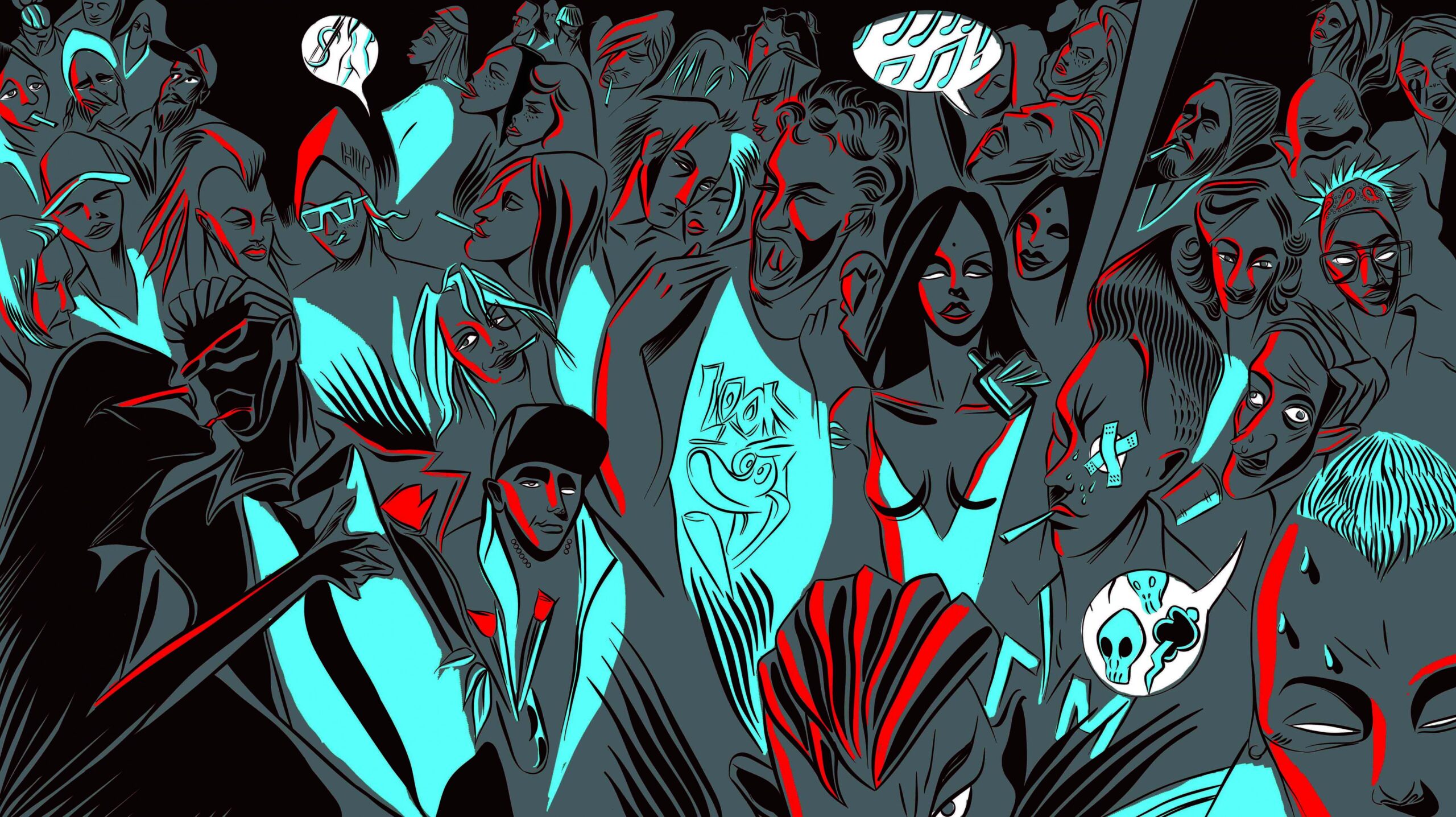
Tracy Chahwan, Beirut, Issue 4: Trans-, (2015)
I notice a very familiar stranger’s face across the room, rotating around her own orbit in a ravishing simple white summer dress. She makes eye contact. I find myself making my way over.
“We’ve shared this dance floor many times a while back, and I never said hello, how are you?” I say.
“Where have you been?”
I shrug my shoulders and pout, take my palms together to the side of my face to gesture that I was asleep. She laughs. Her name is Nahed.
“Nahed, what a beautiful name you have, truly,” I say.
Nahed is a fearless dancer, her hair painting time around her in fiery brushes. It’s like meeting an old friend. I can feel the gentle sun she carries in her. We lock rhythms. Our eyes don’t lose each other. I twirl down like a melting ice cream to the ground, and she does too, with her arms waving like a sea’s heave. She bends backward and forward and shakes her shoulders in a silky shrug, takes her index to her lips, and I repeat. I thank her for existing. Time to part. One day we may find each other again.
I go and check in on Sarah. She reminds me to hydrate and gives me a kiss on the cheek. Only another human can save or ruin you.
“So glad we met, and it’s not the drugs,” she says.
I hold my palms together and drift back to my sanctuary in the corner, nothing but the dance remains of me.
The sweet fishnet-top human spots me. He glides over.
“I like this,” he says and pulls delicately at the silk around my neck.
“So do I.”
“What are you drinking?”
I don’t have anything in my hands. I shrug.
“You don’t get it, I’m buying you a drink, that’s it.”
He gets me a beer, smiles a gentle farewell, and liquefies into the eye of the dancefloor. Around me it’s a blessed riot, nothing but the music and defiant flesh and scarred open hearts made one searching for the umbilical flow like magic, god hiding in the decks somewhere under our starless sky. The pill doesn’t come on too strong but enough for that spark of rightness, alignment in the iris of the universe. Someone touches my shoulder. A stranger holding out her hand. Takes me a second to get it: She wants me to help her get up on that elevated cube, so she can dance up there. Takes a couple of attempts but she makes it. She keeps me company. She, too, tugs at my scarf. We undulate in sync for a while, me down here, writhing and swaying, head tilted all the way back and rolling, looking up at her, she up there, my hair at her knees, doing the same, only her head is tilting down at me. Then she comes back down.
“Are you from here?” she asks.
I can’t place the dialect of her Arabic. “Where are you from?” I ask.
“Syria.”
“I’m so sorry, I don’t know what to say.” I almost tear up from the look in her eyes.
She’s here for a visit, a few days, wants to see the galleries that remain. She loves Cairo, loves this so much.
“I’m leaving Syria. I’m going to live in Naples, I’m going to paint Naples’ light.”
I blow her a kiss.
“Sad to see you leave us but have a wonderful adventure in Napoli,” I say.
“What do you want?”
“You mean in life?”
“No, I mean now, right now, what do you want?”
“Nothing, this moment between us now, it’s heaven in a blip.”
Probably should’ve just said, I want you.
She pulls her phone out and tells me to save my number. She gives me a long hug and saunters away.
I take out the tobacco pouch.
The fish-net guy is holding onto the DJ booth with both his hands, arms outstretched, and then he frees one of his arms, swings it wildly behind him like a whip, his head and waist flung way back; it’s almost as if he’s become a horizontal thing, lava, sultry, a lovely thing cutting across the dance floor like a lithe last supper table.
Where is Sarah? I embark on a tiny tour to find her. She’s in the back in the dark by the bar, kissing someone. The boy has a Hawaiian shirt on, a vintage camera hanging from his neck. Children of paradise. As I’m about to turn, Sarah takes a step back, decoupling from him, and laughs loudly. Slowly, slowly, she says to him, I can read her lips. Then she sees me.
“Are you having a good time?” she asks.
“Who is your pretty friend?”
“I have no idea, his face is just so delectable and he’s not a Capricorn,” she says and chuckles playfully.
“Now I’m hurt,” I say, half-jokingly.
She grabs my arm. “Let’s dance.”
We dance together, and then she says she’s tired, let’s go home.
We make our way back to Maadi, breathing in the music, the wind in our faces. The man from earlier, the man with the loose tie around his neck, where is he now? I say a little prayer for him. May he find stillness and may he be happy and unbroken and safe from harm and free from fear and bondage. Sarah asks me if she can put on some Quran. I must’ve misheard. She says it again.
“Why?!”
“To balance things out.”
“Please don’t.”
She lets it go, thankfully.
When we get close to her street, I slow down. It’s almost four a.m. The birds are about to sing to the day despite it all. The brutalist pedestrian-bridge cuts across the train tracks like a beached-whale ghost. A dog is barking in his sleep on the side of the road. A pharmacist in a white coat is stubbing out a cigarette outside her shop, looking up at the empty sky.
Under an old Eucalyptus tree, the man is sitting, almost exactly where we left him. He’s still here. I look over and Sarah is concerned too. I stop the car and we both get out.
He’s sitting with his head almost between his knees.
“Are you okay?” I ask him.
He looks up, as though waking from a soft dream. I can’t tell if he can see me.
And then I notice the blood, the tributaries of it on his hands. It wasn’t there before.
“They won’t go hungry now in heaven…they won’t go hungry now in heaven…they’re sleeping with the angels now in heaven.”
Omar Refaat is a Cairo-based fiction and creative non-fiction writer.
